

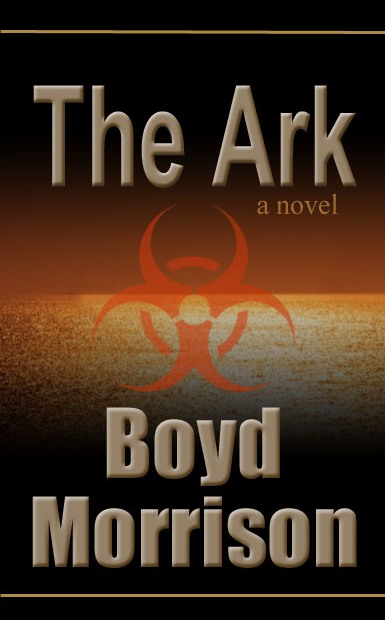
 This week brings news of Boyd Morrison who got a book deal based on his Kindle book sales. This book deal did not happen in a vacuum: Morrison had a literary agent already in place – i.e. publishers didn’t just suddenly notice his level of sales and offer him a book deal. The story is that the book was sent out by his literary agent and it wasn’t picked up. After Morrison’s book, The Ark, started become a Kindle phenomenon, his agent thought about trying to sell the book again, and on the strength of his Kindle sales Morrison got a two-book deal with Simon & Schuster to release The Ark in hardcover and another book in the series. The book is described as:
A relic from Noah’s Ark gives a religious fanatic and his followers a weapon that will let them recreate the effects of the biblical flood, and former combat engineer Tyler Locke has just seven days to find the Ark and the secret hidden inside before it’s used to wipe out civilization again.
Most certainly, it has the scope and feel of The Da Vinci Code, like the novels of Jeremy Robinson, another self-publishing success story. The novel is another example of publishers looking at self-publishing sales to give a writer a book deal – but it is the first time this has happened with the Kindle. Given that Kindle recently lowered it’s price to $299 (still too expensive, but going in the right direction), more and more people will be using the Kindle. But even though the Kindle is composed of niche users – as opposed to mainstream book buyers who might only buy $5.00 paperbacks – the publishing industry still sees this consumer base as a good window into a book’s possible success in the greater market.
So every writer is asking themselves: How can I do this? First you need to get your book into the Kindle store. You can use Smashwords uploader, which will convert a document into .mobi format. It’s not recommended that you only sell a Kindle book via Smashwords, as most Kindle users will obviously go to the source to purchase Kindle books: Amazon. Converting a document to Kindle isn’t always as easy as it sounds, so there are conversion services available.
Using the Digital Text Platform, any writer can upload a book directly to Amazon’s Kindle store. The lowest an independent author can set a book is $.99. A new criticism of Kindle is that only mainstream traditional publishers can set their books for free, whereas self-publishers cannot – making self-publishers’ chances that much more difficult. But still, $.99 is dirt cheap compared to print prices, and given there are only (currently) 300,000 titles available, there is much less competition than in the print market.
Promoting a Kindle Book
In the Gizmodo article it says, “Morrison made a name for himself through frequent participation in Kindle online communities and self-promotion online.” Here are a few places where writers can promote a Kindle book, aside from personal websites. Boyd Morrison also offered his book for free on his personal website, but has since taken the book down from both his site and Kindle since the book deal.
1. Mobile Reads: Share your e-books made specifically for the Kindle (in Mobipocket format). Generally, Mobile Reads is a great resource for ebooks, especially if you’re having troubling formatting or reading an ebook.
2. The Book Corner @ Kindle Boards: As with any forum, just promoting yourself without actually adding to the discussion is not going to be met with great acceptance and friendliness.
3. Amazon’s Kindle Community – People post book reviews and commentary on the Kindle, and authors can get involved – again without overpromoting.
I asked Boyd Morrison about his experience with the Kindle – how he marketed his book and how often and he answered:
I didn’t use Smashwords to upload my books to the Kindle. I simply converted my books to HTML format and uploaded them myself to DTP.amazon.com. It kept the Microsoft Word formatting of my novels intact, and they looked great on the Kindle (I’m a Kindle owner).
The three discussion forums where I promoted my books the most were Kindleboards.com, Mobileread.com, and Amazon’s own discussion forums. Readers on those boards are always looking for something to read (after all, it’s why they bought a Kindle in the first place), and I priced my books for under $2 so that they would have an incentive to take a chance on an unknown author like me. Then word of mouth took over. Response to my novels was incredibly enthusiastic, and once people started buying them, my books started climbing the Kindle store bestseller lists, which in turn put them in front of more potential buyers, creating a positive feedback loop. Then the reviews started coming in, and they were overwhelmingly favorable, with all three books averaging 4.5-5 stars, which convinced more people to buy them. Unfortunately, we readers can be jaded sometimes, believing that an unpublished author getting many five-star reviews could simply be relying on friends and family to act as shills for them, but I can tell you that 95% of the reviews I received were from people I’d never met.
I tried to keep my promotional notices in forums low-key and respectful. No one likes being bombarded by advertisements, and it can be a huge turnoff if authors pepper the boards with announcements, constantly bumping their threads to the top. In fact, most of the forum threads about my books were not started by me, but by readers, which was quite an honor. My favorite Amazon forum thread started by a reader was titled “Boyd Morrison rocks!”.
It didn’t hurt that my novels had wonderful blurbs from bestselling authors like James Rollins and Douglas Preston, both of whom I met years ago at the Thrillerfest conference.
Last but not least, self-published authors should spend some time on a well-crafted book description and polished book cover art. Diane Whiddon-Brown of Novel Website Design designed my covers, and they looked great next to all of the bestselling books that my novels were listed with.
All that being said, when it comes down to the bottom line, you have to have faith that your work will speak for itself. You can’t force or plan positive word of mouth. It just has to happen, and I was lucky enough to experience that with my books.
Lessons from this for self-publishers is that Boyd Morrison had high-profile blurbs and a literary agent, so it’s not entirely a rags to riches story, more like a fairly well-dressed to riches story. But it still bodes well for how traditional publishers are viewing self-released work. Readers are becoming the gatekeepers.
Get an Editorial Review | Get Amazon Sales & Reviews | Get Edited | Get Beta Readers | Enter the SPR Book Awards | Other Marketing Services




Hi Henry,
Nice article 🙂
Mind if I have a small whine?
Hardly any of this is doable for anyone living outside of the USA. Maybe ‘any American writer can’ might be more accurate.
I was exploring the DTP option recently, got my ebook in the right format, followed instructions in the Getting Started Guide carefully… and then came across the ‘… and you’ll need a US bank acct and tax number to continue’ line near the end of the guide. GAH! Stupid Amazon. Although, let me clarify – I could upload, so technically you’re right. I just couldn’t list or sell the thing *lol*
Even though i’m in the uk, i was able to list my eBook on Kindle. You can’t get payment to UK bank accounts, but they send you a cheque (or check, as they spell it) to your home address.
Take another look at the form, near the bank details section there’s a checkbox for ‘send my royalties to me by check’ option.
Andy
Naomi, thanks for writing. Looked into it and Kindle’s coming for the U.K., but it’s delayed:
The delay is partly because the Kindle uses a free wireless service called whispernet, which enables users to download books, and signing up networks around Europe is a complex operation.
http://www.telegraph.co.uk/finance/newsbysector/mediatechnologyandtelecoms/media/3211227/Amazon-delays-UK-launch-of-Kindle.html
Henry, thanks for taking the time to write this article. Kindle is a great supplemental outlet for self publishers. This article can serve as a primer for someone looking to launch a project into the Kindle distribution channel.
The first book I published “How To Make Money At Home In Spare Time By Mail”, I also submitted as a Kindle edition. It was actually easier than I thought.
Bernie Malonson
Great article. I’m also a new author, and I self-published my first novel (historical romance) on Kindle using the DTP platform. Sales were slow at first, and I didn’t do any promotion. I decided to drop the price to 99 cents, and it is selling well now (ranks in the top 3-5% of Kindle book sales), and I’m beginning to receive reviews!
I’m preparing my second manuscript (second in the series), which will also be released on Kindle.
I’m happy to see Boyd’s success story, and hope to follow in his path.
hi everyone.. this article is very inspiring.. i m going to publish my book on ‘lifestyle for beautiful skin’ on kindle. it covers the details of few simple things you can incorporate in youe day to day life to get rid of skin problems like pimples. i think i will go for .99 cents price from the beginning. its not a fiction. so dont know if kindle readers will appreciate it.
Hi Henry,
I am not an American. Am Kenyan. I agree with Naomi. At first when I came across this Kindle self publishing thing, I was so happy. I have a manuscript that I need badly to get out there to be read, but then am not American, so I cannot go Kindle. I guess we Africans need to tie our act together.
Ezekiel – there are other places to sell ebooks, although not with the existing traffic of Amazon. Ie, you have to do all your own marketing to get people to the site. Smashwords is the one I’m currently using.
Thanks for the article. I just published my first short story (not even a novel yet) titled The Last Day on kindle and I don’t have any idea how to get people to notice it. I will say however, it gives me an electric charge of energy to see it for sale in a real marketplace, even if it is digital. I really liked all the tips and am going to try them myself. I wish all of you success and hope to see you where ever it is writers go for lunch.
thanks for the sharing. I just published my first short story about a father and three sones who were all murdered in susecession.this was a real family living in The 1500 AD. thou I chose to tell the story as fiction mixed with fanasty.Into this story (The Fire Sacrifice of tupac) i put in as much wisdom as i could muster up and gave it to my family for christmas, from the heart and not from the pocketbook,they wern’t happy but in time?
Useful information. I hadn’t realised there were forums specifically for Kindle. My second book has been published via the Kindle route so I want to push it somehow.
Thanks for sharing. My mother (Darya Martelle) tried this also and is having some success with the process. I would recommend that everyone take advantage while it’s still free.
http://www.amazon.com/The-Secret-of-CCT-ebook/dp/B003OQUN7W/ref=sr_1_1?ie=UTF8&m=AG56TWVU5XWC2&s=digital-text&qid=1275966949&sr=1-1
Great article! I now have two books priced at .99 and the reviews are great. I haven’t put the second novel in print yet, just because it made more business but now I have changed my mind since the books sales have been propelled by the kindle. The novel is “How Did I Get Here?” After some searching I even found it in the Detroit Public Library. Kindle is the way to go!
This article is very helpful. Many thanks for writing it and for all the detail. It’s hard sometimes for a writer to make the decision on self-publishing. I know it can be a struggle. Every bit of information that can be gleaned on the subject is priceless. Thanks again.
-Wodke Hawkinson
I have four ebooks up on Amazon Kindle now. I am still trying to market them, and myself. I want to create a strong platform. I write horror, so it has been hard to find places to help with the marketing.
This was a very helpful article and much appreciated.
I have also self-published a novel called “The Sexual Revolution” you can find online at http://www.thethaichronicles.com
Check it out, it’s a fun read!
I also have an e-book, about the true-life story of finding out that I was married to my daughter’s molester. Check it out! http://www.amazon.com/My-Husband-Molested-Daughter-ebook/dp/B0052UPOL8/ref=sr_1_1?ie=UTF8&m=AG56TWVU5XWC2&s=digital-text&qid=1306541493&sr=1-1
I have always known that self-publishing is the way to go, and that it may even lead to even greater success!
Thanks for this very informative and innovative post!
Great information for me. Always learning new strategy to use in market my books http://www.amazon.com/Sweat-and-Sweet-ebook/dp/B0051X46WE/ref=sr_1_1?s=digital-text&ie=UTF8&qid=1314621716&sr=1-1
http://www.amazon.com/Winning-Words-Barca-ebook/dp/B00540AJJS/ref=sr_1_1?s=digital-text&ie=UTF8&qid=1314621775&sr=1-1
I found this article most informative. I, too, have just epublished a novel, “A Ghoulish Good Time,” with Amazon, and am trying to promote it. Self-publishing is so new, and frustrating to me!
I released my epic Historical Fiction Novel “Destiny Comes on the Wind – The Legend of Opechancanough” on Amazon Kindle KDP about a month ago. I did not really know what to expect by self-publishing my book. I find it very awkward promoting my book, but facebook and the other social networking sites have been helpful to spread the awareness. I have about a year and a half invested in researching, writing, and editing, but part of that is likely due to the fact it is my first book. I was compelled to write after I discovered that one of my direct ancestors was the Paramount Chief of the Powhatan Confederated tribes and fought two wars against the Jamestown Colony in Virginia. At this stage of my life, I am not primary driven by monetary gain. I priced my 216,000 word ebook low enough to not discourage mass interest. I wish there were more places to self-promote without great expense. I’m certainly open to suggestions to get my story read. Lastly, I have recently made my book free for a limited time to US military service members deployed outside the USA. I’m considering doing the same for the British military as well.
Every writer who’s frustrated by the “Query-go-Round” should try Kindle. Marcie Chan’s story convinced me to give it a try last January. I put my first three novels up at 99 cents in January. A couple of months later, having been turned down by a fourth publisher, I put my fourth novel on Kindle. Last month I added my latest, “The Girl From Area 51.” Total sales are now approaching ten thousand. Do I love Kindle? You bet I do.
Here’s a site to promote your kindle book as well. http://www.bookwormempire.com It’s affordable & I was able to get my book featured.