

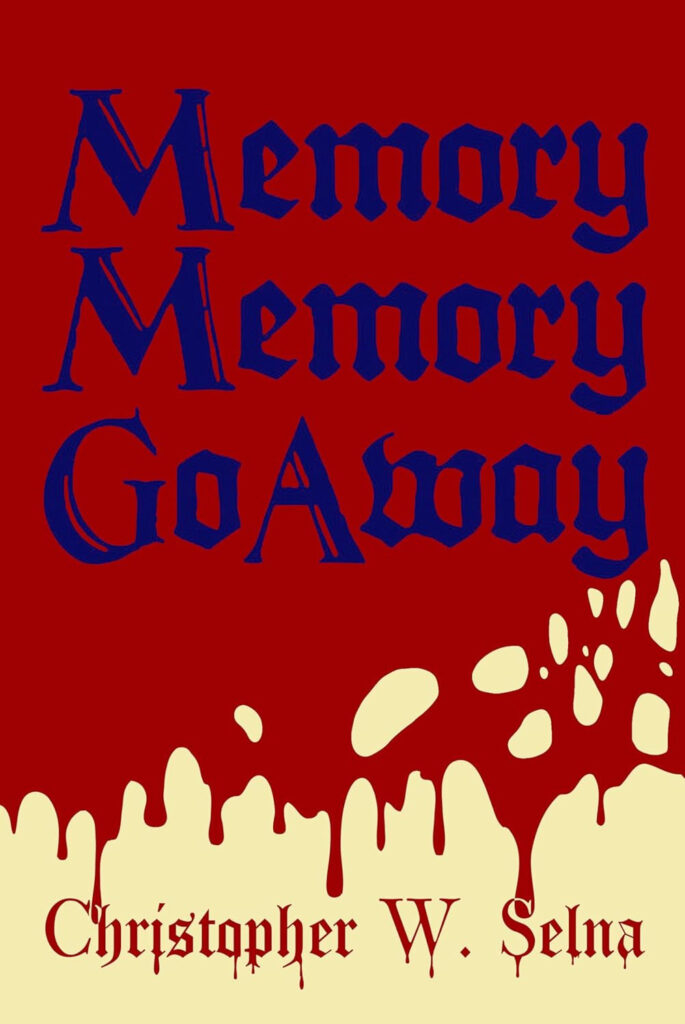
Laden with warnings for our troubled times, Memory, Memory, Go Away by Christopher W. Selna is a timely piece of speculative fiction that echoes with contemporary weight.
In a parallel reality to our own, citizens of the United Founded States of America can participate in a program that wipes away traumatic memories, thanks to the technology of a company called NeuroGlo. Challenging the timeless pillars of religion and the insidious healing power of pharmaceutical drugs, this technology has radically reshaped society’s collective response to trauma, grief, loss, and regret.
At the heart of this rebellion against the societal dominance of Big Pharma and the Church is Addison Cain, the reclusive young genius behind Memory, Memory Go Away. Before a massive merger between this revolutionary company and another corporate goliath, journalist Malcolm Jenners gets an unexpected invitation to interview the eccentric billionaire.
Malcolm ends up whisked off for a raucous underworld adventure with the bizarre and misunderstood tech titan. He’s getting a jaw-dropping inside scoop on Cain and his mindboggling advancements, from cutting-edge extraterrestrial drugs and quantum-level virtual reality to the next generation of addictive escapism, but exploring the inner sanctum of an unpredictable visionary might cost him his sanity, or his life.
Every side of this Selna’s dystopia is layered with satire and not-so-subtle allegory that contemporary readers will recognize. The deification of corporate figures and the cultural zealotry that follows is uncomfortably familiar; Malcolm’s front row seat to Cain’s dark side is a validation of suspicions around the shadowy cabals and invisible power brokers populating our own headlines. In a world increasingly dependent on technology for escape, release, and catharsis, the ability to alter one’s actual memories would be the ultimate achievement, pushing the novel into philosophical realms pioneered by authors like Huxley and Orwell regarding the anesthetizing effects of authoritarianism, the allure of ignorance, and the desperate lengths we go to forget.
The messaging and thematic undertones are compelling, but the prose is rough around the edges, both from a technical and an artistic perspective. Certain scenes and tangential diatribes stretch on too long, losing some steam and emotional energy. Readers may feel inundated by the stream of consciousness storytelling, which can be difficult to sift through for plot movement, as many paragraphs and pages are devoted to casual streams of thought unrelated to the storyline, which add to the atmosphere, but without a focused narrative purpose. Unfettered access to a first-person narrator’s thoughts is a double-edged sword; it can allow for stylized prose, but it also has the potential to lose readers or the plot in loose narrative strains, as realistic as a wandering mind may be.
The author addresses the lack of line editing up front due to certain constraints, which is a bold and even sympathetic move, but acknowledging the lack of polish doesn’t reduce its import. Repetitive sentence structures and word usage can make scenes feel redundant or neglected: “I was helpless against the possessed spirit possessing me.”
All told, this is an uncut but inventive work of speculative dystopian fiction, which is alternately surreal and insightful, and will connect with any reader who has righteous concerns for the future.
Book Links







STAR RATING
Design
Content
Editing
Get an Editorial Review | Get Amazon Sales & Reviews | Get Edited | Get Beta Readers | Enter the SPR Book Awards | Other Marketing Services






Leave A Comment