

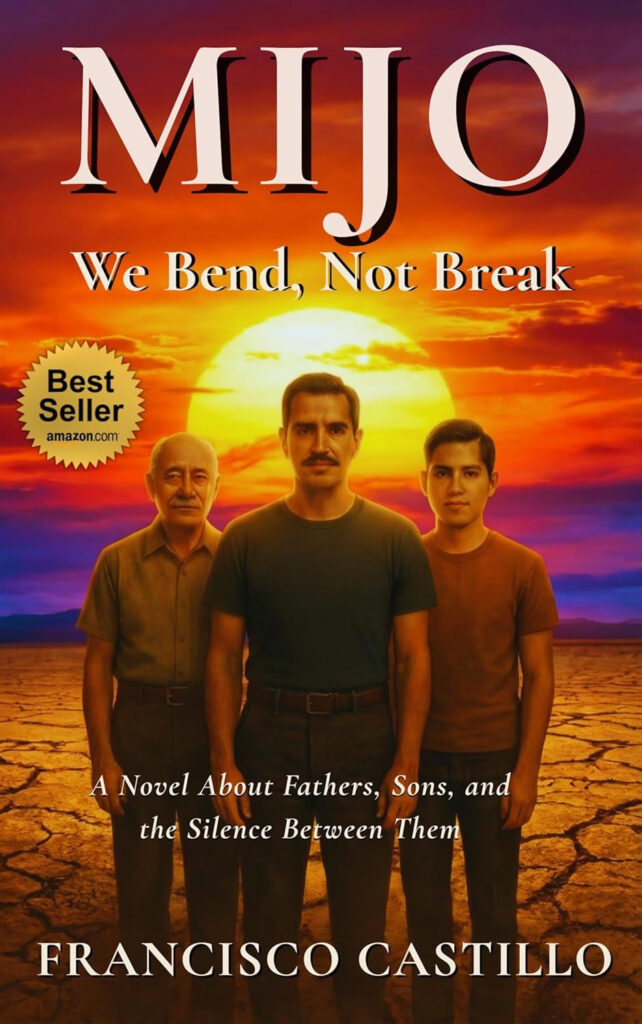
A stirring portrait of the immigrant tradition in America and the burdens of memory that can bury us, MIJO: We Bend, Not Break by Francisco Castillo is an absorbing tale of resilience and reinvention.
Capturing the intergenerational trauma and trajectories of one fearless Mexican-American family, the story depicts the diverse journeys of Joaquín, his son Alejandro, and grandson Gabriel. From the violent dead ends of rural Mexico and back-breaking work in the tomato fields of southern California to struggling up the white collar tower and assimilating into contemporary US culture, this sprawling narrative runs the gamut of the immigrant experience from the mid-1950s to the present day.
Joaquín and his wife first make the crossing into America, where he settles into the exhausting routine of agricultural day labor, leaving little time for paternal devotion once his son Alejandro is born. Decades later, despite promising not to repeat the mistakes of his father, Alejandro finds himself overworked and increasingly disconnected from his own growing family. When the pandemic strikes, threatening the stability and safety for which they have all sacrificed so much, it is an opportunity to reshape their future into one that honors the past, and elevates the true priorities of life.
In today’s contentious climate, where immigration looms as one of the most divisive political issues on multiple continents, stories like this one are more important than ever. Reframing the statistics with dignity, depth, and humanity is essential, given the blunt media landscape and unfair generalizations leveled at the melting pot of migrants, refugees, and asylum-seekers in search of a better life. Castillo is compassionate in his storycraft, but never patronizing or overly sentimental; instead, he elevates the quiet nobility that continues to drive generations of immigrants to fight tirelessly for the ever-elusive American Dream.
Through different generations, the story is defined by a straightforward intensity, thanks to subject matter that doesn’t require a dramatic arc to be impactful. Some of the most powerful scenes are the simplest – a farmworker too exhausted to celebrate his son’s first steps, or a mother bonding over cherished recipes with a daughter-in-law. The rich and authentic dialogue is subtly splashed with sage wisdom about growth, permanence, and legacy, even over something as simple as a backyard garden. Each chapter is concise and vivid, moving smoothly through years and decades without feeling rushed, which allows emotional momentum to build with each successive chapter or time jump.
This evocative story also echoes the author’s own life experience of traveling between two worlds, attempting to bridge the past and future with respect and understanding as a family therapist. Bringing both his personal and professional expertise to bear gives the writing a soothing and cathartic feel, even with its high stakes and emotional tension. The prose is laced with viscerally authentic descriptions of economic desperation, border crossings, cultural hiccups, personal sacrifice, the emotional minefields of family, and philosophical musings on concepts such as home, belonging, fatherhood, and opportunity, which feels as if the novel explores every possible facet of this issue.
On a technical level, the vacillation between Spanish and English can initially be jarring, particularly for English-only readers, but it contributes to the atmosphere of fluidity and immersion. This is also one of many eye-opening examples of unconscious code-switching and behavioral maintenance that immigrants must bear, from “keeping up appearances” by attending church to overachieving in professional settings to avoid stereotypical judgments.
In sum, this is an emotionally rigorous and profoundly important read, no matter what “home” means to you.
Book Links







STAR RATING
Design
Content
Editing
Get an Editorial Review | Get Amazon Sales & Reviews | Get Edited | Get Beta Readers | Enter the SPR Book Awards | Other Marketing Services












Leave A Comment