

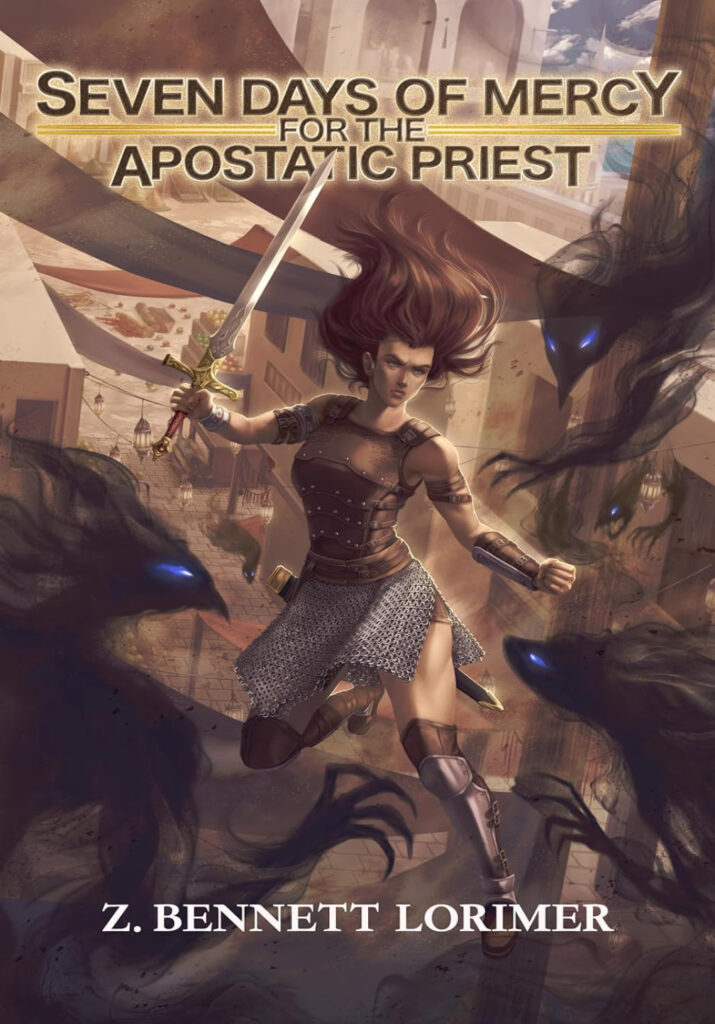
An imaginative plunge into battle for the very soul of a mystical realm, Seven Days of Mercy for the Apostatic Priest (The Divine Heretic Book 1) by Z. Bennett Lorimer is a uniquely captivating novel to launch a new series.
Tasked by her order to slay a reborn G-dling, Ruxindra is a cold and calculating weapon made flesh. Upon arriving at Mahakalpe to carry out her grim task, she discovers that the city hides even more secrets, including ancient wards linked to Eldritch arcana, and who or what they are remains an ominous mystery.
There appears to be a conspiracy in the works linked to the impending celebration of the new Eidolon, adding a violent custom to the otherwise sacred ritual. Heathen tradition has clashed with holy order in a city built on the existential grave of far older and darker beliefs. Radical separatists seek a return to those old ways, and the release of a vicious elder horror that could bring the entire world to its knees.
Disguising herself as one of the G-dlings future spouses, Ruxindra closes in on her quarry, but she ends up sidling closer to the only force that might be able to stop the sinister scheme unfolding across the city. The wily Ruxindra must put her god-killing skills to an unexpected use if she intends to save Mahakalpe, the realm of Hebdomar, and the entire Unseen World from chaos and devastation.
From thaumaturgical glamor and sophist rebels to dark sorcerers, snake-headed butchers, and unexpected saviors, this fast-paced fantasy is an unpredictable blur of genres and coal-dark themes. The prose toys with a range of complex ideas, from the constancy of change and the struggle between the lesser of two evils to magnanimity, sacrifice, and gender inequalities. Ruxindra’s god-slaying nature stands in sharp relief to the sacrificial, sexual, or superficial roles of other female figures in the novel, and her clever subterfuge and narrow escapes are a highlight of the writing. Kenver, the sworn guard to the Eidolon, is another complex and intriguing figure, complicating the forced relationship between Ruxindra and Luka, and acting as an unlikely ally in the dramatic unfolding of the plot.
Lorimer is an author who not only enjoys the play and tension of language, but orchestrates it with seamless agility. The prose is effortlessly impressive, with original turns of phrase, creatively precise metaphors, and exquisitely chosen vocabulary, though even voracious readers may occasionally need to crack a dictionary. On that same note, the book begins without much exposition or background, immersing readers in a world of enigmatic customs, phrases, ethnic groups, and religious practices, but this can be jarring for readers who prefer to be eased into a new fantasy realm, or at least be provided a world map to help visualize the relational sprawl of cities, seas, geographic markers and diverse cultures.
Balancing storytelling complexity, plot speed, and character depth is no easy task, and while the novel is densely packed with detail, it is marked by brilliant twists, visceral stakes, and a mercilessly entertaining hero at its heart.
Book Links




STAR RATING
Design
Content
Editing
Get an Editorial Review | Get Amazon Sales & Reviews | Get Edited | Get Beta Readers | Enter the SPR Book Awards | Other Marketing Services


















Leave A Comment