

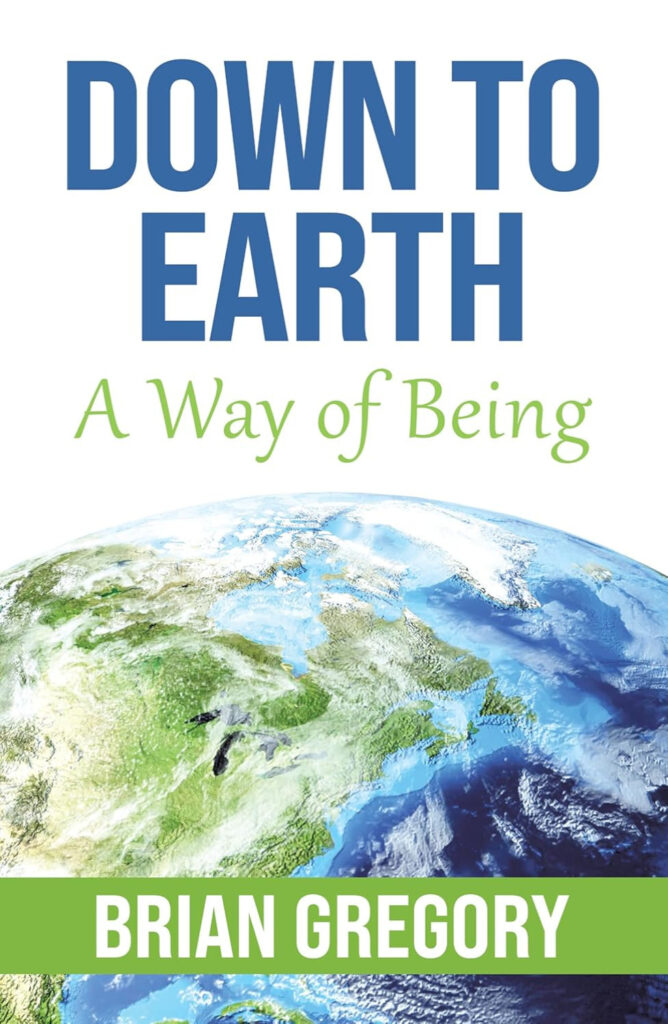
Exploring everything from childhood development patterns to humanity’s meaning and purpose in the universe, Down to Earth: A Way of Being by Brian Gregory offers a curious and compelling new lens for life.
The book begins with an accessible introduction to popular science, the nature of our universe, the unique history of our planet, and humanity’s immeasurable impact on it, coupled with lesser-known concepts – e.g., holarchies of evolution and developmental thought. These “holonic structures” refer to the ubiquitous interconnections between the whole and part that shape every aspect of life, from “atoms—>molecules—>cells—>organs” at the physical level to “core being—>inner being—>outer being” in more emotional and metaphysical realms.
This framework is closely linked to the author’s overall thesis, which states, “being down-to-earth involves nourishing both our growth and development in a vertical sense, and grounding our outer and inner being in a horizontal sense.” Guided by our connections with nature, others, and the sacred identity of our own hearts, we can spend more time being, becoming, and realizing our potential, rather than merely existing and overthinking ourselves into misery.
For most readers, the first half of the book and its broad summary of the Universe, Earth, Life, and Evolution will be a refresher course, but doesn’t offer much in terms of new revelation. After this abbreviated history of scientific and sociological thought, the author then expands his concept of holonic levels with a key example – primal, civil, thrival, and global perspectives – along with discussions of mythical, magical, subjective, and scientific forms of thinking.
The second half attempts to apply some of the key lessons gleaned from the first half, including the fact that humans evolve holonically, everything is interconnected, nothing is predetermined, and the universe is playfully whimsical. The author suggests an Entropian worldview, where one exists in peaceful acceptance of reality’s endless nuance and wonder, rather than unjustified optimism or unyielding pessimism.
Gregory’s discussion of evolutionary periods is one of the more interesting and original elements of the text, and his proposal that these major shifts are speeding up at an exponential rate is soundly argued. His prescription of a new mindset to mitigate our modern condition of high stress is also persuasive, and seems to come from a sincere desire to improve mental health and wellness in others. The reading experience is much more comforting than confrontational, allowing Gregory to take the role of an eccentric friend doling out valuable wisdom, rather than a punitive academic or condescending guru.
That said, the balanced narrative style can sometimes feel too idealistic – ungrounded in the obstacles and frustrations of everyday life. Readers may resonate with the author’s theoretical approach, but the narrative occasionally feels like a long-form thought experiment, playfully pushing at boundaries and challenging firmly set ideas without fully considering the unavoidable realities for both traditional and progressive thinkers alike.
On a technical level, there are scattered typos, missed words, and awkwardly phrased lines that could be tightened up with a final proofread. However, the cumulative structure and concisely presented narrative hint at a high level of intentional editing, so these errors don’t compromise the author’s unique cadence of thought.
All told, this is a thought-provoking, empathetic, and well-researched examination of why we are the way we are, and our limitless potential for personal and communal improvement.
Book Links






STAR RATING
Design
Content
Editing
Get an Editorial Review | Get Amazon Sales & Reviews | Get Edited | Get Beta Readers | Enter the SPR Book Awards | Other Marketing Services
















Leave A Comment