

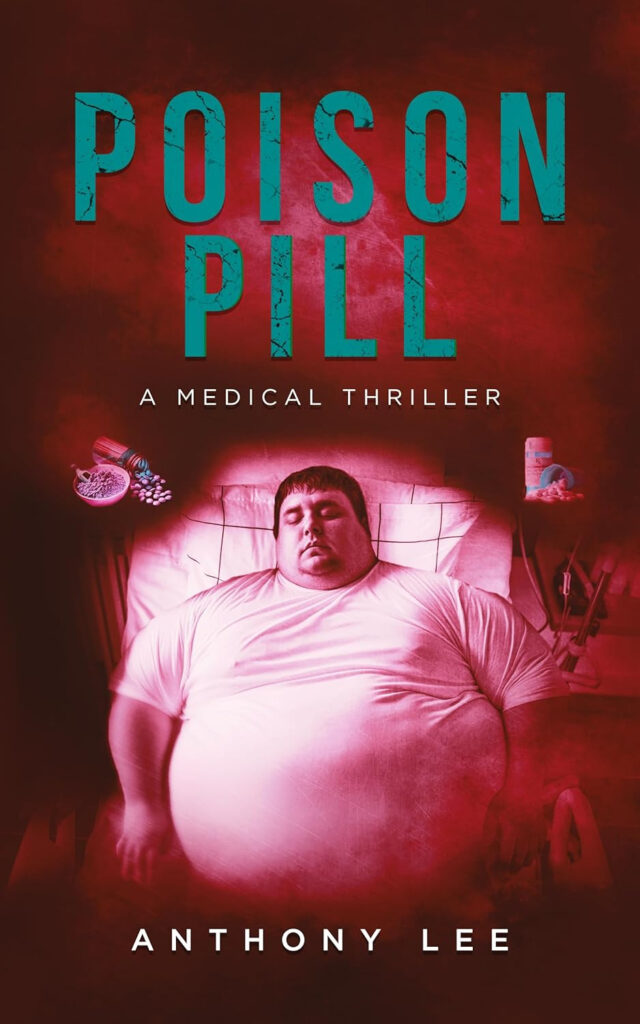
A probing examination into the darker sides of health, Poison Pill by Anthony Lee is a fearless medical thriller told from inside the belly of the beast.
In a span of two days, Dr. Mark Lin is presented with a pair of enigmatic patients – Hector, a person far too young for kidney failure who potentially faces a lifetime of dialysis, and Robbie, a severely obese man with rapidly worsening COPD and no clear cause. In the first case, Dr. Lin suspects the root cause to be an energy and weight-loss supplement called Motileaf, while in the second, he worries that the patient’s shiny new weight-loss drug, Naxipil, may be the underlying culprit.
For the sake of his patients, and countless others, he begins looking into these new pills, balancing his high-stakes days at the hospital with naturopathic conferences, clinical visits, herbal boutique investigations, and phone calls with FDA regulators. When the strings of his suspicion lead to a tangled web of lies worth billions of dollars, he is forced to put more than his career on the line.
Packed with medical mysteries to unravel and well-stoked dramatic tension, the author also takes time for intimate character development, especially when it comes to Mark’s philosophy of ethics, his complex understanding of medicine, and his warranted suspicions surrounding two less-than-trustworthy industries. For non-medical professionals, the prose offers a meticulous level of detail on drug development, testing, approval processes, distribution standards and more, demonstrating how controlled and potentially corruptible these systems can be.
Thematically, the issues explored in the novel are timely, thought-provoking, and important; in our modern era built on the monetization of health, this takedown on the contradictions of our medical system is both welcome and informative. Herbaceutical and non-Western treatments are continuing to grow in popularity as pharmaceutical prices rise, insurance companies restrict access, and increasingly unhealthy populations grow desperate for relief. The core debate of efficacy vs. safety takes center stage in the story, prompting readers to make the same considerations in their own health decisions. In particular, Robbie’s ineligibility for bariatric surgery and his search for a miracle weight-loss cure echo contemporary trends and tribulations around GLP-1 inhibitors.
The stream-of-consciousness style of Mark’s voice gives readers full access to his thought processes, but that also includes instances of unnecessary tangents, a surprising lack of professionalism, and even body shaming, which clashes with his positioning as a noble healer and selfless sleuth. Aside from certain weak spots and convenient storytelling jumps in the plot, there is measurable room for improvement in the writing itself, from unnatural dialogue and loaded exposition to procedural narration (e.g., “Then she begins speaking…”) and choppy scene-setting. Inconsistent slips into first-person omniscient narration can also be jarring, particularly when the narrator’s internal monologue is already so dense and methodical.
A light-touch editor could smooth out these stray issues to strengthen the novel further, as the majority of the writing is engaging, immersive, and purposeful. For readers who want a cutting-edge contemporary drama that tackles critical issues with empathy and curiosity, this latest installment of the Dr. Mark Lin Medical Thrillers series is both entertaining and eye-opening.
Book Links




STAR RATING
Design
Content
Editing
Get an Editorial Review | Get Amazon Sales & Reviews | Get Edited | Get Beta Readers | Enter the SPR Book Awards | Other Marketing Services










Leave A Comment