

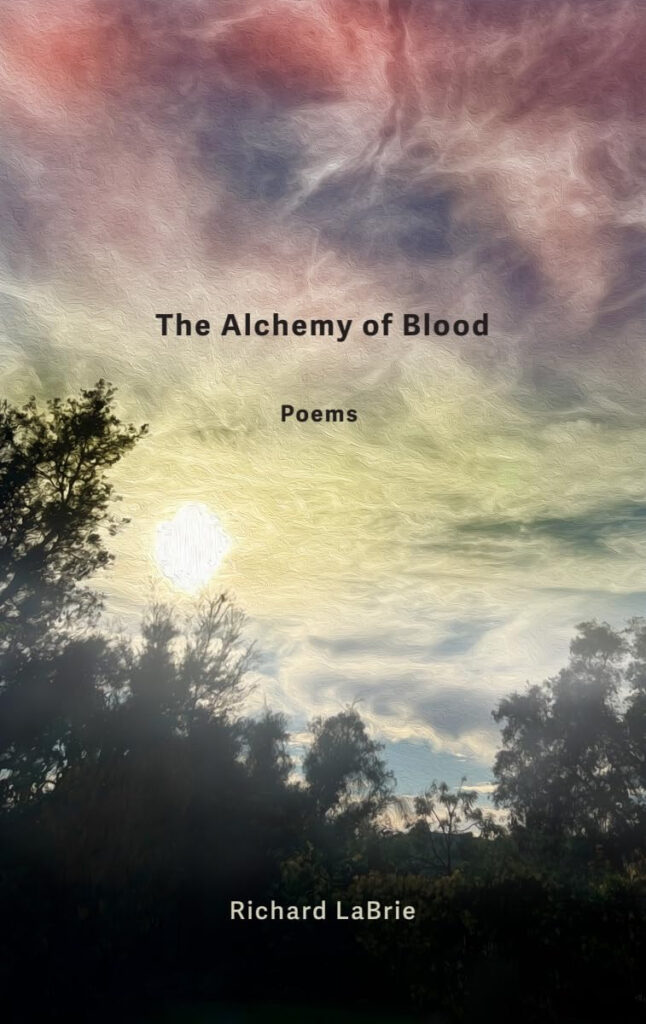
Raw, unguarded, and ultimately hopeful in the face of harsh reality, The Alchemy of Blood by psychologist and poet Richard LaBrie transmutes the creeping despair of an observant healer into a striking collection of sensitive artistry.
Divided into four distinct sections – Nigredo, Albedo, Citrinitas, and Rubedo – these poems mirror the progressive spiritual path outlined by Carl Jung. The work does not strive for clinical distance or assume authority in its proffered wisdom; instead, the speaker(s) in these poems are curious, playful, flawed, and often accidentally profound.
The first section, Nigredo, is marked by themes of self-destruction, anger, regret, a sense of hopelessness, and even envy of the dead, all of which align with Jung’s concept of catharsis and the challenge of viewing reality with brutal honesty. “The Fragility of the Dahlia Stem…” and “Carbon Options” both include tongue-in-cheek commentary on the state of our modern world, and the endemic flaws of contemporary society.
The following section, Albedo, centers on rebirth and rediscovery, from the legacies we leave and the holy simplicity of existence to the potent desire for a golden future in “If Only I Burn.” A sense of determination and stubborn resilience underwrites this second chapter, specifically in pieces like “Not Quite Bipolar” and “Seeking.” The third grouping of poems, Citrinitas, centers on the pursuit of unlearning and re-education that is required for higher-order understanding and personal evolution.
As heady as that summary sounds, the poetry within is direct and unflinching, whether LaBrie is castigating the corruption of powerful men, observing the smallest beauties of life, or diverging from those who have failed to grow over time. “The Gemini Capsule” is a compelling reflection on aging and the gravitational pull of our personalities, for better or worse. The poet closes his collection with Rubedo, a soul-stirring blend of humble revelation, self-awareness, appreciation, and a reframing of our conception of perfection. As in the Buddhist tradition, we are reminded that one can glimpse enlightenment from many angles, even within a child’s innocent hope – those “Jeweled sprigs of everything to be.”
Varying widely in poetic form, experimental structure, and even visual orientation, these creatively curated pieces gently explore a myriad of emotional realms, from youthful guilt and casual nihilism to timid optimism and existential elation. Within each of the four cohesive sections, LaBrie regularly surprises readers with gut-punch lines and provocative confrontations, making the poetic experience an existential blur of confession, self-reflection, and reconstruction.
The more intimate anecdotes peppering this collection suggest an autobiographical work, but overall, the poetic voice feels amalgamated and diverse, a composite drawn from years of clinical observation in psychological spaces. As a clinical psychologist, LaBrie is particularly qualified to wax wisely on the subject of spiritual and emotional evolution, along with specific changes in perspective as humans age or mature, but he avoids heavy-handedness, binary thinking, or narrow pathways for “success,” for a collection that manages to be both subtle and hard-hitting.
On a technical level, from enjambment and form-play to word choice and abruptions, LaBrie excels in the crafting of accessible but unpredictable verse. A worthy homage to the legacy of a titan, LaBrie’s lyrical collection is a kaleidoscopic plunge into perspective, progress, and our perennially malleable minds, resulting in a stirring work of poetry that can double as an intensive psychological treatise on self-actualization.
Book Links





STAR RATING
Design
Content
Editing
Get an Editorial Review | Get Amazon Sales & Reviews | Get Edited | Get Beta Readers | Enter the SPR Book Awards | Other Marketing Services












Leave A Comment