

Placement, Framing, and Findability: Engineering Editorial Endorsements for Impact
“Google can bring you back 100,000 answers. A librarian can bring you back the right one.” —Neil Gaiman.
Treat endorsements as your on-page librarian: the thing that steers a skimmer to the right reason to care.
Why Amazon elevates editorial endorsements (and how to use it)
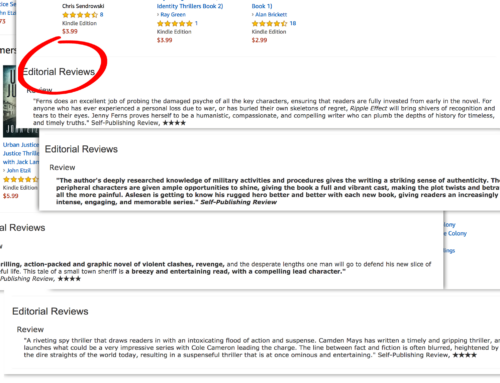
Authors can add endorsements in Author Central under “Your Editorial Reviews.” This section appears high on the detail page and is under your control, unlike customer reviews. It is the appropriate, policy-compliant place for promotional language, whereas the customer review space is explicitly not for promotion.
Formatting for scanners
- Qualifier-first. End your quote with an em dash and the source; bold the source. Identity signaling matters.
- One promise per quote. Keep it to a single, concrete benefit (“a lucid, evidence-rich history”) rather than a string of adjectives. Concreteness tracks with perceived usefulness.
- Order by authority. Lead with outlets, juries, and domain experts; then notable authors; then niche influencers. This ordering mirrors how readers weight identity.
A/B ideas you can run without a data science team
- Order test. Rotate endorsement order for 7–10 days while holding ad mix constant; compare conversion deltas.
- Length test. Compare ≤30-word vs. ~50-word versions during a stable traffic window and inspect downstream actions (sample, add-to-cart).
- Source-first vs. source-last. Some audiences respond to “Source: Quote” layouts; others prefer quote-led. Test both.
What professional endorsements actually do (in scientific terms)
- Set priors at the point of first fixation. Behavioral work on reviews shows that language features shape perceived helpfulness and that readers do process text, not only stars. Editorial pull-quotes are your controlled text at the top of the page.
- Stabilize interpretation against biased averages. Because ratings are often J-shaped, a clear frame (“quiet literary mystery,” “evidence-driven pop-science”) reduces mismatched expectations that lead to one-star ratings.
- Create portable assets. Endorsements belong in Author Central’s Editorial Reviews, the product description, and your A+ Content modules; keep promotional copy out of customer review space to comply with policy.
Findability: how endorsements and reviews reinforce your name/title in search
Google’s own documentation is plain: its ranking systems use many signals; your aim is to give those systems clear, consistent evidence about the entity that is you and your book. Stable pages that mention your name and title, then point to your site and retailer page, help corroborate the entity behind branded queries. Use canonical practices on your own site so link equity isn’t split among duplicates.
Do this
- Ensure each press endorsement you cite on your site or in your media kit links to a permanent URL on the source’s domain (when available), and to your canonical book page on your site.
- On your site, consolidate variants of your book page (with/without trailing slashes, parameters) to a single canonical URL, and use a sitemap to reinforce your preferred version.
- Expect lag: Google indicates ranking impacts may take weeks. Plan campaigns accordingly rather than assuming same-day lift.
Cautionary science corner
- Dynamics, not statics. Duan, Gu, and Whinston model WOM and sales as a feedback loop in movies: sales drive WOM and WOM drives sales. Your endorsements can catalyze this loop by improving early conversion, which yields more readers, which yields more reviews.
- Negative publicity is context-dependent. Some studies show negative press can help unknown products by raising awareness, but it’s a volatile bet, and you can’t choreograph it. Focus on clarity, not courting controversy.
“Your brand is what other people say about you when you’re not in the room.” — Jeff Bezos.
Endorsements teach people what to say; reviews show that people are saying it.
Get an Editorial Review | Get Amazon Sales & Reviews | Get Edited | Get Beta Readers | Enter the SPR Book Awards | Other Marketing Services












Leave A Comment