

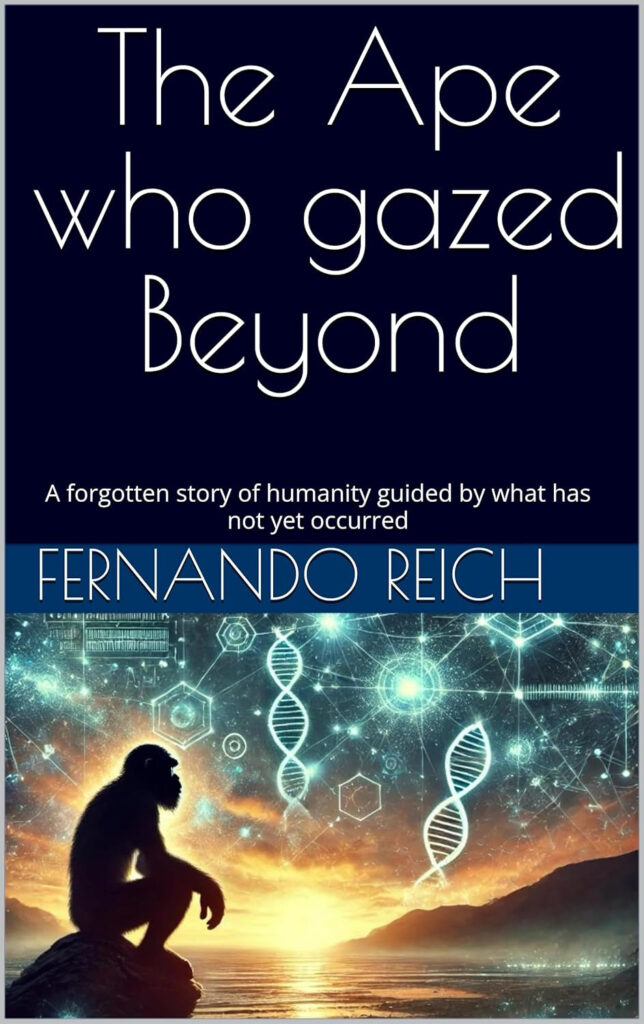
A heady exploration of our collective past, future, and the pathways in between, The Ape Who Gazed Beyond: A forgotten story of humanity guided by what has not yet occurred by Fernando Reich is an illuminating poetic reflection on humanity’s potential.
Penned by a tech veteran fascinated with quantum connections and species consciousness, this is a remarkably accessible and inviting collection of ideas on where we came from, where we’re headed, and how we’re actually going to get there. From walking upright and discovering the function of fire to developing language and sharpening the tools that would build our future, this thought-provoking examination of humanity is an anthropology, history, and philosophy lesson rolled into one.
The second part of this book takes readers through the Agricultural Revolution, the written word, the creation of God, and the birth of science, with each poem building cumulatively on the last, crafting a foundation for who we are. The third and fourth sections address humanity’s evolution into self-awareness and critical thought, along with the overwhelming power of technology and perpetual emergence of a fated future that has always been waiting.
One of Reich’s central ideas is that humans are not solely motivated or inspired by the past, but also drawn forward and invited by the future, as though the ever-unfolding present is remembering us, and we are growing to meet it. The poet’s passion for quantum entanglement inspires this type of play with nebulous definitions of time and space, as well as the flexibility of mortality and the magnificent possibility within a single lifetime.
While discussions of cosmic paradoxes and non-Newtonian physics have the potential to get technical and lumbering, Reich leans into the metaphysical elements of these concepts, keeping the language simple and craftily distilling complex ideas. At times, the adage-style writing can be vague, speaking more in riddles than strict logic, but the writing still manages to instill the sensation of delivered wisdom. Dabbling in realms of determinism, destiny, and the inevitability of our becoming, the content is ethically curious and philosophically flexible, albeit self-assured in its argument.
On the technical side, there are a few bad habits that emerge in the writing – for example, Reich tends to use a -/+ framework to dramatize a statement, which loses impact over time, e.g., “Perhaps it wasn’t necessity. Perhaps it was vision.” The motif of interrupting a descriptive phrase with more specificity is also overused: “There is a human gesture—deep, trembling—that whispers…” Regardless of each phrase’s originality, the rhythm can feel repetitive, no matter how sage the book’s advice. The halting thoughts, list-leaning style, and line breaks feel more like prose cut into verse, rather than creative enjambment, which can make these pieces come across as articulate blog musings, rather than a collection of genre-blurring poetry.
Poets have an obvious broad license for content, but these pieces often read as short streams of thought, or abstract essays, and could use more poetic variety. That said, every piece is punctuated by memorable lines and cliffhanger conclusions, and the collection overall provides rich food for thought not found in many works of poetry.
Book Links



STAR RATING
Design
Content
Editing
Get an Editorial Review | Get Amazon Sales & Reviews | Get Edited | Get Beta Readers | Enter the SPR Book Awards | Other Marketing Services










Leave A Comment