

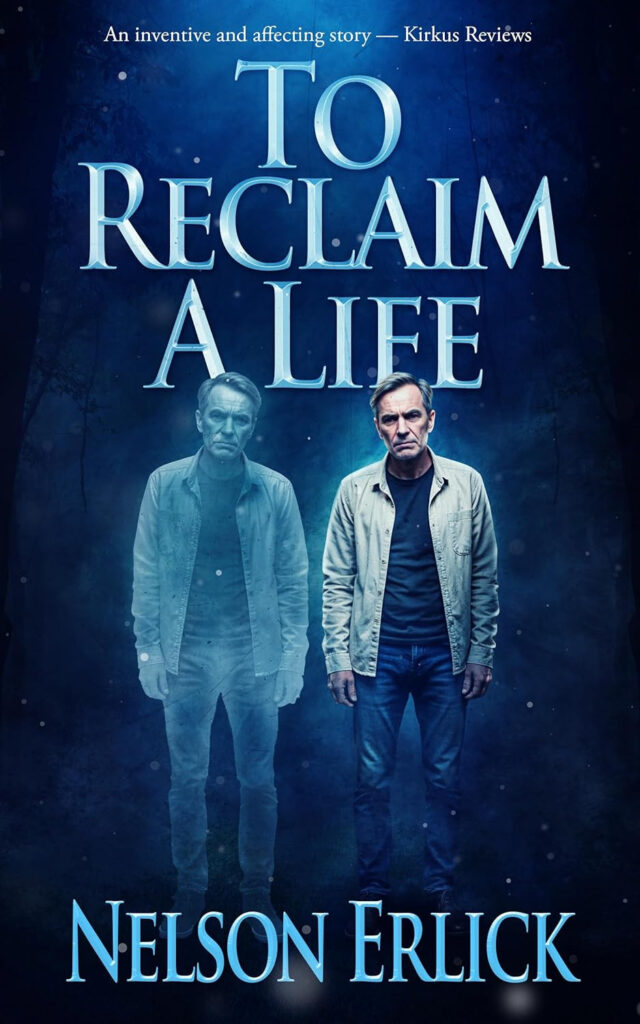
A gritty and unflinching musing on living, dying, and the purgatory that can exist between the two, To Reclaim a Life by Nelson Erlick is a penetrating look at the human psyche.
Following the slow decline of his relationship with Rebecca Wilson, the last love of his life, Richard King faces the tragedy of watching her commit “suicide by cancer.” On her deathbed, she makes him promise to avoid any erratic behavior for two years, a thinly veiled request that he not take his own life, no matter the darkness of the days ahead. He honors her plea, while constantly battling the unforgiving voice in his head, a disembodied force he has named Knot.
As he debates the pros and cons of continuing his existence, readers are carried through the turning points and traumas of his life – the events that both defined and devastated him. Knot is a constant companion through these recollections, urging Richard to either face the suppressed truth of his memories, or to bend and reshape his experiences in ways that are easier to swallow. As they journey through the past, Richard is forced to face the harsh realities of how his life has veered off course, and potentially find a reason to keep fighting for a brighter future.
The narrator’s insightful and keenly aware analysis of his own inner monologue is a revealing look at negative self-talk and the terrible master that the human mind can become. While many stories explore our inner voices, this novel stretches and extrapolates that divide to its breaking point, holding a mirror up to some of the most destructive and covert enemies to mental health; Knot acts as a character unto itself, often divorced from the desires and personality of the protagonist. The fact that Knot is a product of Richard’s mind, yet also an active combatant in his war of wellness, exposes a dark truth that is so difficult to face: we are all too often our own worst enemy.
This juxtaposition results in two unreliable narrators trapped in the same body, leaving readers to parse through lies, facts, memories, manipulations, and defense mechanisms. Erlick’s expansive descriptions of the Up and Down Phases of The Cycle will be brutally relatable to readers who have wrestled with their own demons of self-loathing, suicidal ideation, overwhelming grief, existential apathy, schizophrenic symptoms, and uncontrolled anxiety. Some parts of the novel will be triggering at times, and cathartic at others, but no part of this hard-hitting narrative feels superfluous, or hyperbolic.
The narrative creates a voyeuristic level of intimacy that is rarely captured with such grit and grace, making this a rare and raw confessional that reveals the darkest sides of human nature. Thematically, the novel touches on everything from grief, regret, and self-deception to betrayal, abuse, and abandonment, but these intense topics are softened with black humor and shoulder-shrugging acceptance that everyone is fighting a hard battle.
On a technical level, the writing maintains a manic cadence, mirroring the often disjunct flow of thoughts that we keep to ourselves. The scenarios that Richard and Knot cycle through capture the scattered and unhinged habit of obsessive overthinking, artfully combining into an unforgettable profile of noble suffering.
Singularly unique, but ringing with relatability and brutally won wisdom, Erlick’s novel is a searing testament to resilience and the quiet wars we wage within ourselves.
Book Links





STAR RATING
Design
Content
Editing
Get an Editorial Review | Get Amazon Sales & Reviews | Get Edited | Get Beta Readers | Enter the SPR Book Awards | Other Marketing Services
















Leave A Comment