

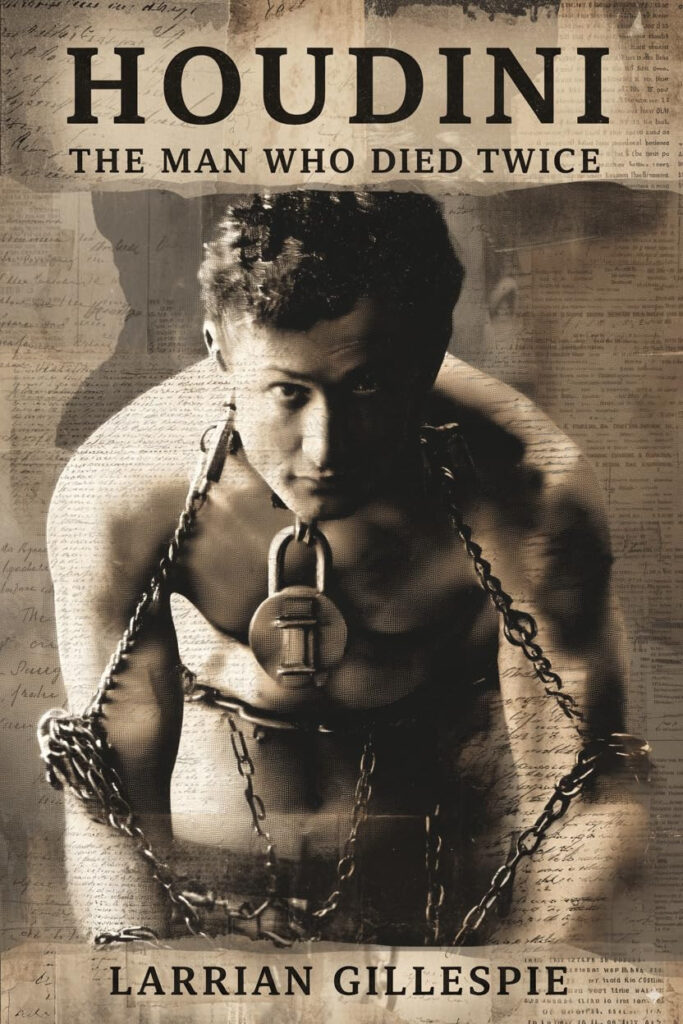
Pulling back the curtain on history’s most legendary magician, Houdini: The Man Who Died Twice by Larrian Gillespie explores the spectacular career, enigmatic legacy, and murky final days of the macabre master of escape. Readers are pulled a century into the past to a time of glamour and illusion, where fame and fortune could be won or lost in an instant.
Delivering an impressive example of well-researched and riveting nonfiction, the book unfolds like a formal investigation – a presentation of verified facts and the players involved, alongside a dissection of the relevant clues and motives, allowing a theory to gradually develop on the page; like any good murder mystery, the narrative doesn’t give away too much too soon.
Transporting readers into the frenetic and alluring age of showmanship, Gillespie paints a comprehensive portrait of a man who feels larger than life, filled with death-defying moments, historic spectacles, and complex psychological wounds. The value of the book lies in its attention to minutiae, but it doesn’t get lost in the weeds, maintaining momentum and mysterious energy as readers slowly begin to understand the many layers, motives, and theories surrounding Houdini’s death.
A compelling reminder that “history is often written by repetition rather than verification,” this exhaustive and original examination of the great magician’s death(s) is a fascinating read for fans of the occult, dark history, and good old-fashioned mystery. For veteran fans of and newcomers alike, the storytelling is riveting, as it not only captures the meticulous details of Houdini’s life and self-made myth, but also explores the psychological forces that drove the masochistic magician to such impossible heights, for an indelible portrait of eccentricity, intensity, and talent.
To steal a line from one of Houdini’s own literary reviews, this story is “masterfully peopled” with enigmatic stakeholders and shadowy relatives central to the case, as well as obscure characters that whirled at the edge of Houdini’s orbit, easily overlooked, but still close enough to call their innocence into question. Gillespie summons these figures with startling clarity – the freedom-seeking wife, the overshadowed brother, the embittered sister, the creatively calculating lawyer, or the life-saving stagehand.
Despite the neatly structured outline and the objective presentation of historical facts, the writing often feels like masterfully penned fiction, either pushing against the boundaries of reality or mesmerizing readers with lines that are both visceral and poetic: “On the couch, photographs pile up like old debts – the kind only heartaches bother to collect.” At other times, the author adopts a more journalistic or academic voice, probing through old documents and forgotten relationships, and delving deep into a historical phenomenon or practice that has tangential relevance to the case.
These sections, which pull the lens away from Houdini for a paragraph or page, tend to slow the pace more than others, though they will appeal to fans of antique oddities or anachronistic cultural trends. The occasional digressions aside, this real-time hunt for the truth is a satisfying cross between fact-finding and folklore, hidden behind sly theatrics and blurry history.
All told, the book is an immersive investigation and a stylistic mirror of the life Houdini crafted – cloaked in mystery and tangled with secrets, but wildly entertaining, and worthy of stunned applause.
Book Links






STAR RATING
Design
Content
Editing
Get an Editorial Review | Get Amazon Sales & Reviews | Get Edited | Get Beta Readers | Enter the SPR Book Awards | Other Marketing Services














Leave A Comment