

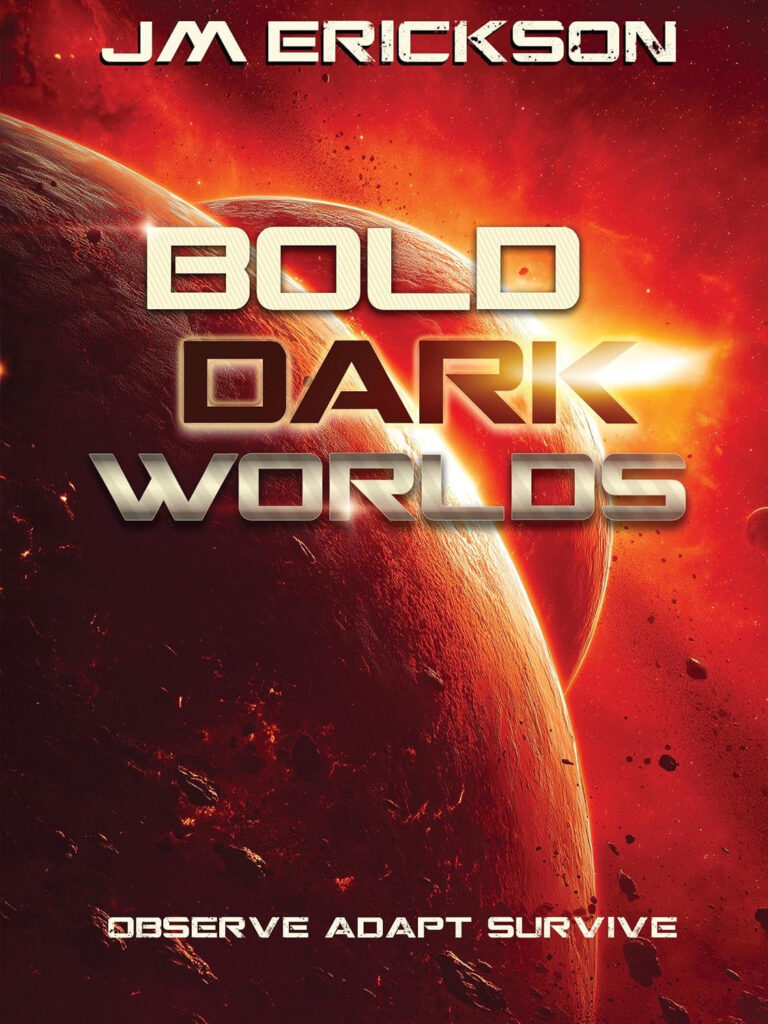
A sprawling sci-fi saga challenging our present reality with a stark vision of the future, Bold Dark Worlds by JM Erickson is an incisive and timely epic.
Composed of four previously released books – Endless Fall of Night, Heavy Weight of Darkness, Deadly Going Dark, and Hunting Armed Men – this omnibus is set a century in the future, in the caste-divided Third Republic, a not-so-distant reimagining of America. The first installment focuses on Cassandra Kurtz, a member of the elite patrician class who is persecuted and imprisoned for resisting the “natural” order of things. When her presence is demanded off-planet in connection with colonies going dark, she is reluctantly paired with Captain Willard Bennett for a mission into the heart of Martian resistance.
The second book finds the disgraced Captain Bennett being offered a chance at revenge and redemption against the rebel who ruined his career, but crushing Cassandra’s campaign for Martian liberation would mean accepting his role as an oppressor. The third book steps into another interrelated corner of Erickson’s expanding universe, focusing on David Strong, a victim of patriarchal power that ventures into the Dark Zone, where he unexpectedly finds his guiding light. The series concludes with a satisfying collision of ideologies, ambitions, and worldviews, in which the fate of Cassandra, Mars, and humanity itself will be decided in the unforgiving dust of a resilient wasteland.
There are few protagonists who stand as tall as Cassandra Kurtz and Willard Bennett, each offering an intensely satisfying character arc. The two protagonists carry much of the series on their indomitable shoulders, and their entwined evolution as insurrectionists, defectors, traitors, rebels, and revolutionaries is operatic and inspiring. Erickson also deeply develops his secondary characters, supporting storylines, and irascible villains, from David Strong’s cerebral isolation and singular narrative voice to Robert Lee’s appalling worldview and murderous depravity.
In the tradition of classic prophetic sci-fi, the philosophical explorations of this series seem like an inevitability for contemporary readers as tech titans exert more control, individual liberties disappear, and class consciousness feels discouraged at every turn. Readers are fully immersed in a kaleidoscope of perspectives and are consequently challenged to interrogate their own feelings on a wide array of subjects, from runaway wealth inequality and neocolonialism to the existential risks of AI and the glaring contradictions of “democratic” society.
While the dense world-building and strong undercurrent of social critique make this an enveloping and eye-opening read, there are a few issues with the technical execution, such as repetitive word use, choppy sentence structure, and dry exposition that can undercut tension and lower emotional stakes. These issues may drop readers temporarily out of the narrative illusion, though the arc of the novel on the whole is strong, consistent, and clearly imagined, so these moments can be easily overlooked.
Despite some superficial and structural issues, the scale and raw power of this series are palpable, balancing dramatic action and space opera immersion with provocative themes and potent moments of revelation, for an impressive standout in the genre.
Book Links






STAR RATING
Design
Content
Editing
Get an Editorial Review | Get Amazon Sales & Reviews | Get Edited | Get Beta Readers | Enter the SPR Book Awards | Other Marketing Services











Leave A Comment