

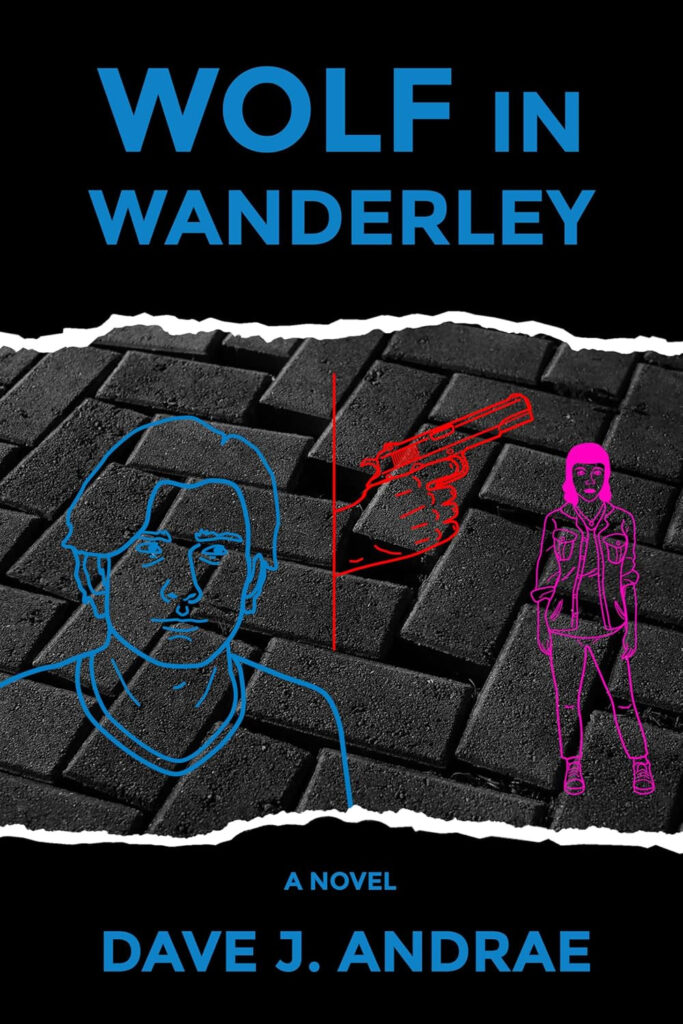
An unapologetic tribute to Gen X mentality and the timeless frustrations of aging, Wolf in Wanderley by Dave J. Andrae is a story of haunted pasts, hope for the future, and the cruel paralysis of the present.
Facing the downward slope of his modest career as a fringe filmmaker, Wolfgang Barnes hunkers down in Florida, settling into the limbo of life’s next chapter while working on his version of a memoir. After an unfortunate encounter with a mace-wielding neighbor, Wolf meets Maisy, the punk-rock twenty-something next door, and her mother Katherine, armed with her boomer logic and skeptical caution.
Unbeknownst to Wolf, a bitter shadow from his past spins back into his orbit, eager to even the score after serving his time behind bars. As Wolf considers the impact, purpose, and value of his life’s work, he simultaneously prepares for the imminent arrival of a long-lost enemy and the chaos that will inevitably follow.
Arranged like a colloquial feast for linguists and grit-loving logophiles, the prose is acrobatic and sprawling, matched in quality by probing, razor-sharp character development. Maisy is an uncompromising rebel, wise beyond her years and a philosophical foil to Wolf, the vaguely lost and existentially exhausted artist – an “aging creative with dwindling influence.” Lenny is an unsettling and calculating ex-con, prone to both clinical reason and sudden violence, which readers discover in the book’s shocking opening chapters.
Both men are in search of redemption from semi-specific regrets, and while they share a capacity for self-reflection, their resistance to change borders on the sociopathic, or at least curmudgeonly. Helpfully, the omnipotent narration gives readers splashes of insight that surpass what Wolf or Lenny possess: “In trying to move forward, or just keep his head above water, he’d been at the world’s mercy more than he’d ever anticipated.” Like the works of Colson Whitehead or Jonathan Lethem, this novel is a genre-blurring piece of urban anthropology, following the strings of a few oddly tangled lives as they quietly lead readers into much deeper revelations.
The author’s thematic focus on arrested development and male maturation feels germane to a contemporary audience, as do so many of the anxieties and concerns that arise for the protagonist. Technofeudalism, violence against women, governmental corruption, climate change, rising fascism, and the ostracization of independent art are just a few of the subjects explored across Wolf’s bumbling and reflective journey. What begins as a sharply penned portrait of a midlife crisis becomes a timely cultural commentary on everything from trad wives and genocide denial to smoking bans and the cynicism of youth.
On a technical level, there are some weak moments in terms of storytelling and verbal panache. By establishing a baseline of ornate language, the less artful phrases and lines seem more flat in comparison. Most of Wolf’s erudite rants are polished and profound, but others slow the overall pace and do little to build on the readers’ understanding of his worldview.
Aside from these editorial critiques, the caliber of the acerbic prose is undeniable, as is the author’s firm grasp on the unifying foibles of the human condition.
Book Links







STAR RATING
Design
Content
Editing
Get an Editorial Review | Get Amazon Sales & Reviews | Get Edited | Get Beta Readers | Enter the SPR Book Awards | Other Marketing Services



Leave A Comment