

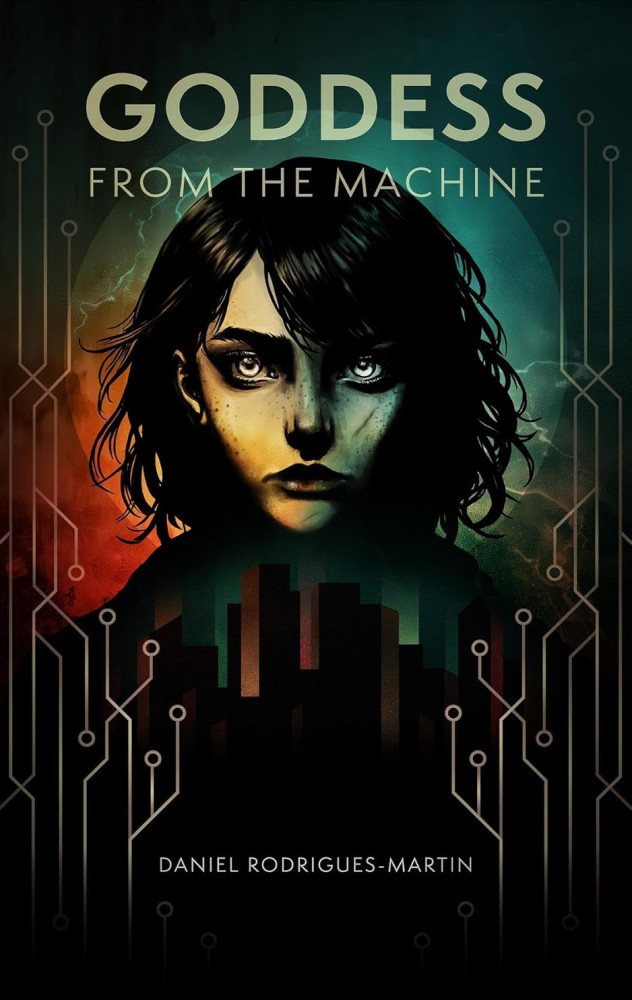
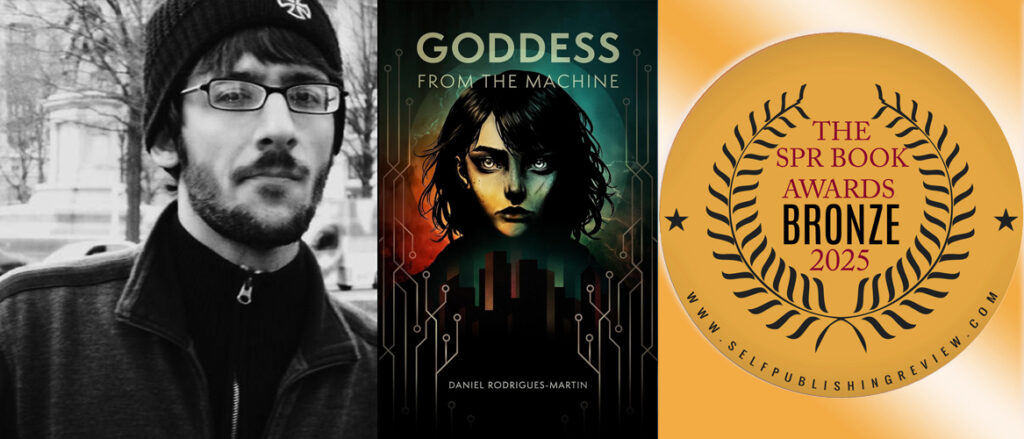
 Daniel Rodrigues-Martin began writing in 2004. Since then, he’s become the author of books, articles, essays, shorts, scripts, poems, a master’s thesis, and countless rants. His debut novel, Goddess from the Machine, was selected as one of Kirkus Review’s Best 100 Indie Books of 2025.
Tell us about your book.
Goddess from the Machine is my debut novel, recently honored as a Kirkus Reviews Best 100 Indie Book of 2025 and a BlueInk Review Best of 2025. The book is about an orphaned genius named Reese who befriends a superpowered vigilante named “Kid.” They work together to dismantle slavery in the steampunk City of Machindoun.
After Kid vanishes, Reese augments her body with cybernetics to get vengeance on those who’ve taken everything from her. The story explores themes of justice, power, free will, and found family atop meticulous, but never overbearing, worldbuilding.
What tools or companies did you use, and what experience did you have?
I didn’t utilize a professional editor because I am one. While self-editing lengthened the process, it also saved me thousands of dollars. If you can develop the skills over time to do this well, you should. Goddess from the Machine was written on OpenOffice, Scrivener (a great tool for managing large projects), and Microsoft Word (for the formatting precision). I ultimately published paperback and eBook editions through IngramSpark. The audiobook edition was distributed through InAudio (formerly Findaway Voices) and was performed and mastered by the award-winning UK duo Rhiannon Moushall and Henry Willard. Once I decided to self-publish, all the tools and resources were ready to go.
 What tips can you give other authors looking to self-publish?
Always revisit the question: “Why am I doing this?” And don’t be surprised if the answer changes over time. Not every story needs to be sold, or even published. Never forget why you started doing this in the first place. Regardless of what your critics say or how many sales you make, be proud of the accomplishment, because the vast majority of people never even write a book.
Tell us about the genre you wrote in, and why you chose to write this sort of book.
Goddess from the Machine is a cyberpunk-dystopian story in a science-fantasy world. Anything orbiting the relationship between our humanity and our tools, like transhumanism, fascinates me, but I also wanted to ensure the story was fundamentally grounded in Reese as a character – her trauma, her agency, and her character growth. It’s a character-driven story with a lot of philosophical weight.
Who are your biggest writing inspirations and why?
George Lucas and Lucas-era Star Wars have to be mentioned for the sheer scope of worldbuilding and the cross-genre implications of doing this well. Joss Whedon at his peak knew how to do ensemble casts and dialogue better than most. JRPGs from the mid 90s to early 2000s for the stylistic action team-up and “hero’s journey” structure. Patrick Rothfuss is a gold standard when it comes to writing with an authoritative character voice. Other writers and artists inspire me because of their ethical, philosophical, or craft-related impacts: John Gardner, William Zinsser, Sol Stein. Into the Woods by John Yorke was really useful, and I loved Madeline L’Engle’s Walking on Water.
What are your plans now your book is published?
My next book is Ghost in the Autumn Vale: Book 1 of the Ark Saga and takes place 4 years after Goddess from the Machine. It’s a dual-narrative story that follows a government agent and an aging bounty hunter who are separately hunting the same superpowered fugitive…and what happens when the three collide. GAV will be out this year. I am also writing Devil in Embryo, a direct sequel to GFTM, and I expect this to be out in late 2027 or early 2028.
Why did you write about this particular subject?
I wanted to write about who Reese was before we meet her in later books because she is such an important “glue” character, but I also wanted another set of eyes through which to view “Kid” at a different time in his life. The themes of forgiveness, power, justice, and found family are close to my heart, and probably difficult for me NOT to write about. In terms of worldbuilding, I’m interested in history, language, religion, and technology, and I had a lot of fun weaving that into the background of the story world.
How does your work/academic background differentiate your world-building?
My formal training is in history, religion, and languages, not storytelling. Because I am a natural storyteller, I made a decision a long time ago to invest my “skill points” (nerds unite!) into writing. I knew that I loved stories and wanted to tell them, but I didn’t feel a calling into screenwriting, journalism, or novel writing as my “day job.” So I pursued my formal training while also working really, really hard to understand stories, editing, and writing.
The key is not to pursue certain fields of study over others to succeed in worldbuilding. The key is restraint. When we understand what storytelling is, we can make worldbuilding fun and interesting rather than cumbersome because we know where it belongs. I’d say Goddess from the Machine and the broader Ark Saga have a lore Bible even Brandon Sanderson would respect, but I want those things to show when necessary and to be active always in the background.
What role does character agency play in your storytelling, especially within speculative fiction?
Stories are about characters and how they move through the world. No matter what we write, we need to remember this. So I wanted to ensure that Reese had a lot of agency even though I’m writing in a subgenre that’s well-known for getting lost in details and speculation. All that stuff is fun, but characters are what we remember, and even if plenty of stuff happens to them, we need to see them fighting to make meaningful choices. This is something a lot of books about writing, storytelling, and screenwriting emphasize over and over, and something I’ve emphasized as an editor.
What benefits are there to critical acclaim as a self-published author?
Feeling good about yourself, which is definitely not nothing. Kirkus Reviews awarded me a star and compared my book to Netflix’s Arcane, which was quite flattering and, I’d agree, apt. Acclaim opens doors to unique opportunities, but the challenge there is that when we self-publish, for better or for worse, we take on the full responsibility for our success.
My sales are good but not great because I’ve invested more into reviews, contests, etc., rather than direct marketing. This has helped me get into libraries without needing to call and beg, which is super cool, and it’s also established credibility. I’ve been approached by several publishing professionals, yet I had one foreign rights deal fall through at the 11th hour because my sales weren’t good enough. I hadn’t put the money into marketing. Storytelling is about heart and art, but publishing is a business – never forget this.
Author Links






Get an Editorial Review | Get Amazon Sales & Reviews | Get Edited | Get Beta Readers | Enter the SPR Book Awards | Other Marketing Services

Leave A Comment