

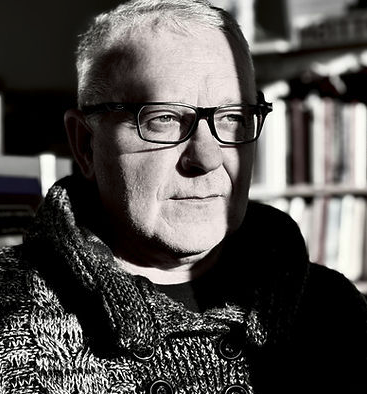
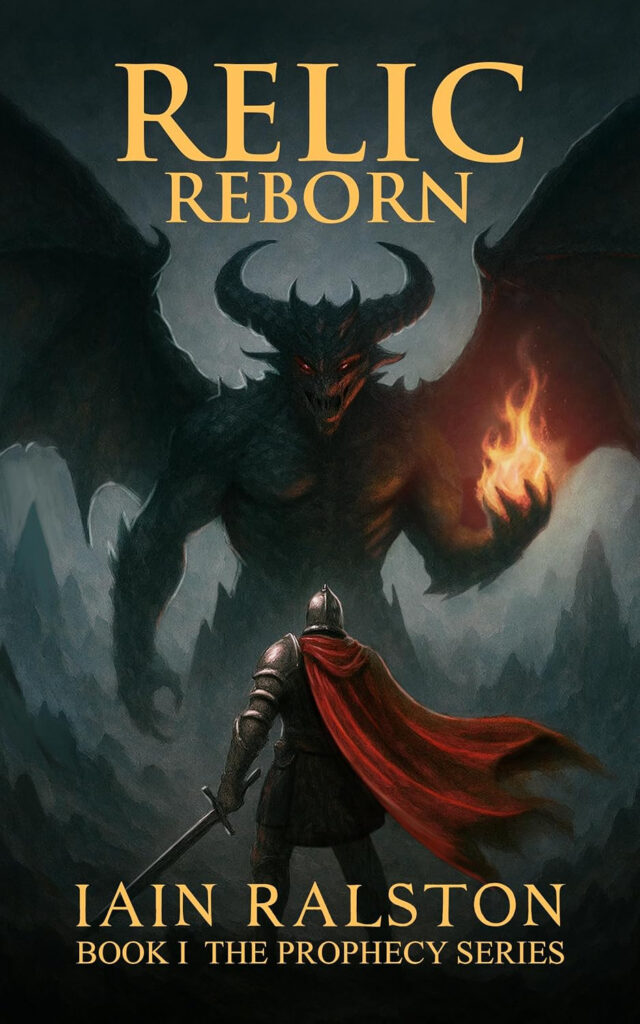
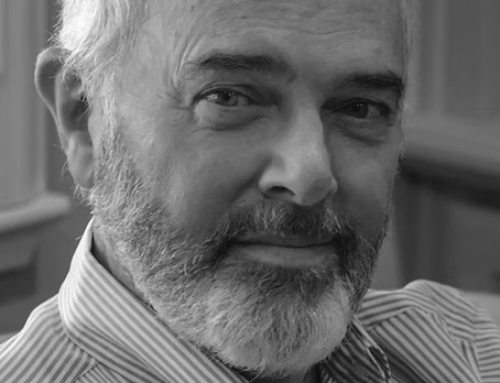
 Iain Ralston is a Scottish author of adult epic dark fantasy and creator of the world of Azangrail. After a serious car crash three years ago, he revisited his passion for writing. His debut novel, Relic Reborn, begins The Prophecy Series, an expansive fantasy saga of prophecy, power, loyalty and the consequences of difficult choices.
Published through House Gloomborne Ltd, an independent imprint, Iain writes character-driven fantasy on an epic scale, combining political intrigue, dark humour, brutal conflict and morally grey and complicated characters.
When not writing the next journey into Azangrail, he can usually be found discovering another part of social media he didn’t realize he needed to learn.
Tell us about your book.
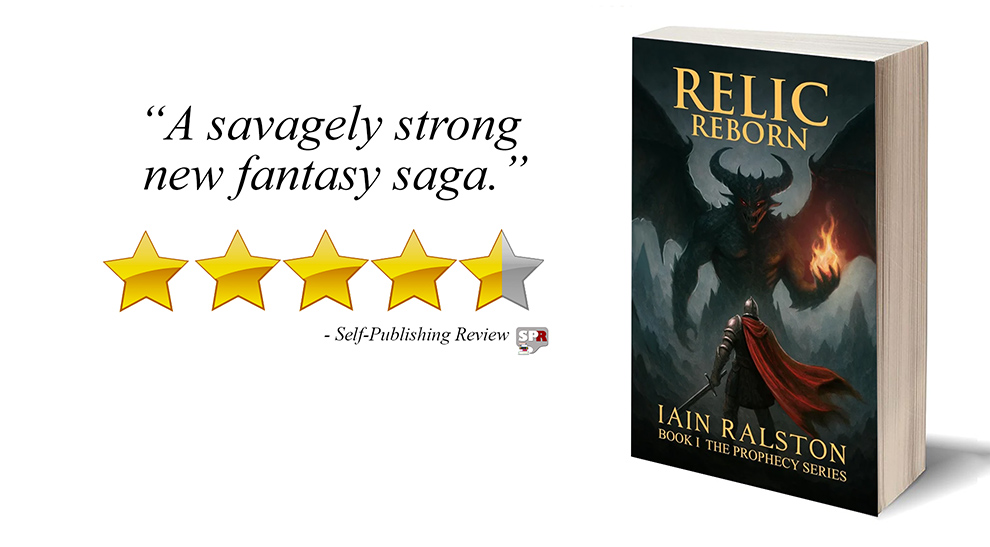
Relic Reborn is an adult epic dark fantasy novel and the first book in The Prophecy Series, set in the world of Azangrail.
It’s a big story with a large cast, different cultures and factions, political manoeuvring, old grudges, dangerous ambitions and quite a few people making decisions they may later regret.
I wanted Azangrail to feel like a real world rather than somewhere that appeared conveniently for the story. It has its own histories, religions, politics and conflicts, much of which existed long before the events of Relic Reborn and some of which will be discovered in later novels.
There are grimdark elements, but I would call it epic dark fantasy rather than pure grimdark. It can be brutal and morally grey, but there is also loyalty, friendship, sacrifice and humour in amongst it all.
Nobody in Azangrail gets an easy ride.
Why did you want to write a book?
I have always read fantasy and loved the idea of disappearing into another world for a few hundred pages. And it had crossed my mind when I was still at school that I might write my own novel, but it never quite materialised. Eventually I reached the point where reading other authors’ worlds wasn’t quite enough, so I started building my own.
Azangrail began with characters, bits of history, cultures, places and ideas that gradually started fitting together. Before long, what I thought might be one book had become something considerably larger.
I wanted to write the sort of fantasy I enjoy myself, a large cast, multiple points of view, political intrigue, dark humour, violence that actually has consequences and characters who are rarely entirely right or entirely wrong.
Unfortunately, as can happen, life and work placed more and more demands on my time, and the writing was pushed further and further to one side.
However, after a serious car crash three years ago, I picked my writing up once more. And while I was routinely attending hospital and physiotherapy, writing became an important part of my recovery and gave me a purpose. And now three years later, while my recovery is still ongoing, the novel I always wanted to write is now complete and another two are in progress.
 Why did you choose to self-publish?
Control, mainly.
I wanted control over the book itself, from the editing, cover, formatting, pricing, publication schedule, distribution and how it was presented to readers.
It was never a case of, I’m right and others are wrong, but I didn’t want to be constrained by set word counts, or the latest trend in covers. I had an idea of what I wanted and working collaboratively with others allowed me to gain advice and expertise and still have the final say on the direction of my novel. I did throw out some of my own ideas, and suggestions from others were fine-tuned along the way. I believe it worked well.
I also wanted to build something longer-term rather than simply publish one novel and see what happened. It was about planning a series and companion novels to immerse my readers in the world, and have them wanting to know more. It was never about throwing a book on a website and seeing how it did.
The downside is that you very quickly discover how much work you actually need to do. The upside is that every decision is mine. If something works, brilliant. If it doesn’t, I know exactly who to blame. And I learn not to do it again.
What tools or companies did you use, and what experience did you have?
More than I originally knew existed when I started this journey.
I formatted the book myself in Affinity Publisher as I knew how I wanted it presented. It was a steep learning curve, and I only scratched the surface of this software.
I did use a professional editor, proofreader and a cover designer for the areas where I wanted specialist help. I felt that I would be too close to my story to see any plot holes, information dumps and so on, hence the professional editor, who was brilliant. Veronica worked with me through every page, and I genuinely can’t thank her enough. A proofreader and cover artist also have specialist skill sets that I knew I could never learn well enough to do justice to my novel and ensure it was presented as professionally as possible.
For printing and distribution, I have used Amazon KDP, IngramSpark, and Bookvault, and I use Nielsen for ISBNs and book metadata. My website and direct bookshop are built through Wix.
Before starting, I knew what I wanted to write and how to write a book. I didn’t know nearly as much about trim sizes, gutters, bleed, wholesale discounts, metadata feeds, ISBNs, barcodes, print costs or why moving one piece of text by half a millimetre can suddenly become the most important problem in your life.
But you learn quickly. Usually because something has gone wrong.
What do you think are the main pitfalls for indie writers?
Thinking the difficult bit ends when the manuscript is finished.
Writing the book is obviously a huge amount of work, especially a 184k-word novel, but polishing it and publishing it introduces another list of jobs entirely: editing, proofreading, covers, formatting, ISBNs, metadata, pricing, printing, distribution, websites, marketing and the dreaded social media.
Any one of those can cause problems if you rush it.
I also think there is a danger in assuming that being independent means doing absolutely everything yourself. It doesn’t. There are things I am happy doing myself and others where I would much rather have someone who knows considerably more than I do.
I would never have completed this without my editor, Veronica Jorden. Her expertise in spotting issues with my manuscript made a huge difference to the final book. Also, a proofreader and cover artist, for me, were invaluable.
To any author, I would say know what your limitations are and go and find the expertise where you need it. Independent doesn’t mean you have to do it all yourself. Yes, there can be costs, but there are a lot of authors who will be happy to share their knowledge and contacts and put you in touch with the right person. And you may be surprised that the cost is not as much as you thought.
The other big pitfall is becoming so obsessed with launching Book One and trying to ensure it is perfect, and then Book Two never gets written.
A launch lasts a short time.
The books are the career and the readers will want to know what happens in the series, not just the first book.
But I would add, none of it matters if you haven’t put the words on the screen. Get the manuscript finished. No matter how bad you think it is, get it finished. It can always be edited, pieces repurposed, scenes added. But if you don’t finish it then none of the issues or pitfalls that may lie ahead will matter.
What was your steepest learning curve during the publishing process?
Outside of social media, probably distribution and the business side of publishing. There are an astonishing number of ways to get a book from a Word document into somebody’s hands, and every one appears to come with a different set of rules, costs, discounts and terminology. And that is different again depending on which countries you want to market your book.
ISBNs, print specifications, wholesale discounts, retailer margins, metadata, territorial pricing, distribution channels – none of it is particularly glamorous, but it matters.
I also learned very quickly that having a book printed and having a book available properly through retailers are not remotely the same thing. I wanted to understand how online retail, bookshops, wholesalers, direct sales and print-on-demand all fit together rather than simply tick boxes and hope for the best.
I made a conscious decision that just because I was an indie author didn’t mean my book couldn’t be as professional as a traditionally published book. It has probably caused me more grief and anguish than the actual writing, but I understand the industry much better because of it. And I hope the next release will be a little less painful.
As a writer, what is your schedule? How do you get the job done?
I try not to treat writing as something I do when inspiration appears. When I wrote Relic, it was all writing, then I had to block out writing sessions for the second book and the origins novel while editing Relic.
Now I am having to adapt my routine again to facilitate the launch of Relic, the editing of Deadly Shadows and Forgotten One, while drafting the next novel. It has proven to be quite challenging to stick to it and not be diverted to something else that is urgent. And there is always something else that is urgent!
Now I am working on three writing sessions a week, and I try to aim for around 3,000 words a session and if I’m having a good session that can rise to 5,000 words. It can take me around 4 to 5 months to finish a novel before it goes to my alpha reader and then my editor.
Other days are used for editing, marketing, and all the other things that arrive once you decide being an independent author is the road for you.
Separating those jobs helps, as does being disciplined. If I am writing, I try to write rather than suddenly decide the website desperately needs to be redesigned or that I should spend two hours investigating paperback distribution.
The main thing is consistency. Three to five thousand words written today are useful. Ten thousand words I might write in two weeks when the stars align are not.
Tell us about the genre you wrote in, and why you chose to write this sort of book.
I write adult epic dark fantasy because it lets me do pretty much everything I enjoy in a story.
I like large worlds, long histories, different cultures, politics, wars, religions, grudges and events happening hundreds of miles apart that eventually collide. Though not necessarily in the same novel, I do like an arc that can play through books.
The darker side comes mainly from the characters. I am much more interested in people making difficult choices than obviously good heroes fighting obviously bad villains. I want the reader to understand the hero’s decision but not be happy about it, or even have some empathy for the villain, while not overtly rooting for them.
People can justify terrible things to themselves all the time, particularly when they believe they are doing them for the right reasons. That interests and intrigues me, and I try to show the process that leads the characters to those decisions.
I also like consequences. If somebody is injured, betrayed, frightened or loses somebody, I don’t want that forgotten three pages later because the plot needs to move on.
Epic scale is great, but the individual characters living through it still have to matter.
What did you learn on your journey as an author?
That writing a book and publishing a book are two completely different jobs.
Writing taught me patience. Publishing taught me more patience, just in a much more irritating way.
There are hundreds of tiny and time consuming decisions involved in producing a finished novel, most of which the reader will never notice if you have done them properly.
And that’s probably how it should be.
I also learned that criticism is useful without automatically being correct. Editors, proofreaders, and early readers can identify where something is not working, but ultimately it’s still my story, my voice and I have to decide how best to fix it.
The biggest lesson is probably that there is always something else to learn or fix. Usually five minutes after you thought you had finally worked everything out.
What’s next for you as an author?
More Azangrail.
Relic Reborn is only the beginning of The Prophecy Series. The second book, Forgotten One, is already written and out with alpha readers. And I have plotted the main series across six novels, though that isn’t set in stone. And my goal is for a September 2027 release for Forgotten One.
I am also writing companion books that explore the characters and events outside the main series. The first is Deadly Shadows, which follows Kerr and Markus before the events of Relic Reborn and I am aiming for a March 2027 release. The plan is to build Azangrail over a number of novels rather than jump from one unrelated world to another every time I finish a book.
There are characters who appear briefly in Relic Reborn who have entire stories behind them, parts of the world readers have barely seen and events that happened long before the opening chapter that still have consequences and may well play out through the series.
So what’s next?
Quite a lot of writing, which I look forward to. And a lot more editing, unfortunately.
Author Links






Get an Editorial Review | Get Amazon Sales & Reviews | Get Edited | Get Beta Readers | Enter the SPR Book Awards | Other Marketing Services




Leave A Comment