

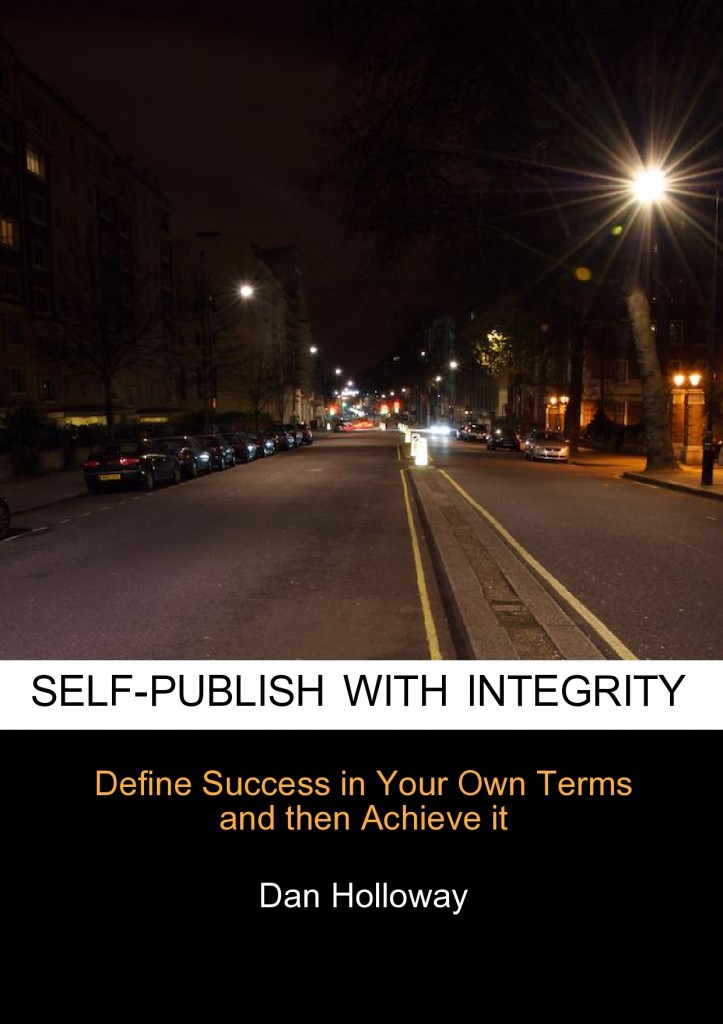
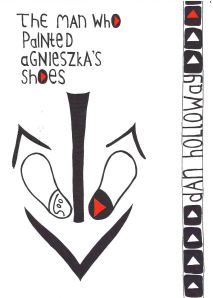
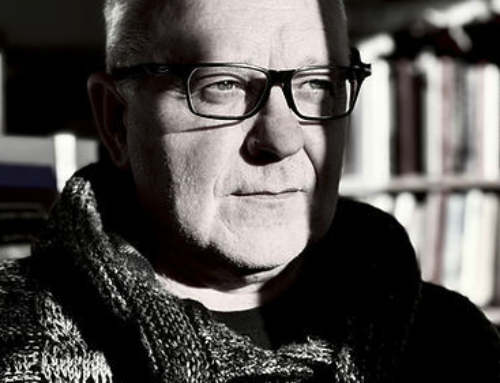
 Dan Holloway is the author of the self-publishing manual, Self-Publish with Integrity, as well as the self-published novels, The Man Who Painted Agnieszka’s Shoes, Songs from the Other Side of the Wall, and many others.
SPR: What is “Self-Publish with Integrity”? Is it more of a manifesto about self-publishing, as opposed to nuts and bolts info on how to self-publish?
Dan Holloway: I’ve written plenty of manifestos in my time, such as the retro-sensualist manifesto, but this isn’t one of them. It’s intended as a guidebook to help people steer a course through the labyrinth of well-meaning (and less well-meaning) advice that swamps anyone entering the fray. There have been several times when I’ve felt a sense of unhappiness or ill-defined malaise in my writing journey, and when I’ve really examined them, I can put them each down to having taken a wrong turn in order to follow what seemed at the time like helpful advice or a great opportunity, only to find that I was traveling away from where I really wanted to be as a writer. The problem was I had never fully articulated where I wanted to be, and as a result I had no fixed point to use when I was making these decisions. That’s what I want to encourage people to do in this book – preferably before they start, but in reality at any point along the way – to ask themselves what they actually want from their writing. And not as a generic “I want to tell stories” or “I just have to write” thing, but to nail down something absolutely concrete. And then I take them through the whole process, from how to publish to building a community around their work, helping them to use that mission statement as their compass.
SPR: You come from the more artistic side of self-publishing. A poet, a literary writer. The surge in self-publishing’s popularity is due to (some) people making a lot of money. Do you think this detracts from self-publishing’s intrinsic value – free expression, artistic freedom?
DH: I don’t think it detracts from the value, because what self-publishing *can* be isn’t changed by what it *is*. On the other hand the narrow band of self-publishing that the  media, and self-publishers themselves, trumpet about makes me livid. Because it’s cheating readers. The most exciting thing about self-publishing for readers is that it offers something they *can’t* get through the mainstream. And yet I see post after post exhorting self-publishers to emulate traditional publishing, to encourage them to say meekly “look, with our covers and our editors and our well-constructed story arcs, we’re just as good as you.” And that makes me want to throw things across the room because that’s like a caged bird flying out the door and saying “ooh, look those iron bars over there look nice.” Only it’s worse than that because there are readers involved, and readers are being told constantly, “look, here’s the best of self-publishing, it’s as good as you’ll get form the big 5” and that is such a lie.
The great things happening in self-publishing are those things you’d NEVER get from the big 5 – zines and handmades and interactivity and genre-bending books of unfashionable length and stories from those voices marginalized by the mainstream. That’s why I shout so loudly and annoy so many people for criticizing self-publishing icons and orthodoxy. And I won’t shut up about it, because the simple fact remains that readers are being cheated and those writers doing truly original things are being cheated because we have a media saying “look at this, it’s new and exciting” and pointing at the same old same old (talking about delivery, rather than content – I seem to remember saying exactly this in a piece I wrote for you about 3 years ago!), and now with all the “best of indie” book sites we’re seeing popping up we have the same thing – these sites are claiming to promote the new and exciting but look at their submission criteria and you see things like “well-constructed fast narrative” and “professional looking covers” and, well, it just makes me mad.
SPR: What are your thoughts on JA Konrath sharing his profits? At the risk of taking on a behemoth, I find this pretty off-putting – “Look at how rich I am.” Obviously some of this is jealousy, but the whole reason I got into self-publishing was because mainstream publishing was so money-obsessed. Is your book a reaction to all the talk about profit?
DH: JA Konrath is an irrelevance to any kind of writing I’d ever be involved in. But yes, my book, and most of what I do, is a reaction to the obsession with profit.
SPR: Do you think there’s a good future for literary work with self-publishing? The money-makers are commercial fiction, same as it ever was. It’s hard to make any kind of living writing literary fiction – whether it’s traditionally or self-published. Do you think literary fiction will have its self-publishing moment? Or has it already?
 DH: I think it’s changed. When I started self-publishing in 2008/9 self-publishing was all about mid-list, high-quality literary fiction and genre bending. The heroes were people like Marion Stein and Maria Bustillos, and names I came across would be people like your own Kristen Tsetsi. It was all about great, unusual content. The mainstream didn’t have a place for that. Nowadays, I could reel off 10 or 20 new small presses who are putting out stunning experimental work and getting it to a wide audience. There *is* a place for high class, original literary fiction in the mainstream through presses like And Other Stories, Lazy Fascist, Bluemoose, Galley Beggar and the like. Combine that with the media’s refusal to talk about artistically interesting self-publishing, and the refusal of prizes that focus on the literary end of things (other than the Folio Prize) to open their doors to self-publishers, and I find it increasingly hard to justify self-publishing for literary authors, despite the fact it feels like our natural home.
SPR: To reframe the above question – it’s harder to have integrity when you need to put food on the table. Sometimes you need to sell out by design. How does one maintain artistic integrity in such an enormously crowded field with a diminishing number of readers – only due to get more crowded?
DH: Selling out by design I have no problem with. The literary world is huge and there’s space for everyone. What I want to address in this book is the issue facing people who don’t want to sell out but find themselves following a more commercial path than they wanted to because they didn’t articulate what they wanted from their writing. It’s very easy to do – promotional sites like Bookbub require a number of 4 & 5 star Amazon reviews, other sites like Awesome Indies require a certain kind of writing before they’ll accept you. It’s easy to think you have to conform to these models, and make your artistic choices based on these requirements, and then wonder months later why you’re not as happy as you thought you would be with your book. Knowing exactly what you want from the outset and sticking to it is the way to avoid that disaffection. I think anyone who can write true to their artistic vision and expect it to put food on the table is incredibly lucky to have an artistic vision readers will flock to in their droves. Not everyone is so lucky, and I think if we really expect both artistic integrity and money we’re fooling ourselves. Worse still, we’re confused – what’s your single priority? Write to that!
SPR: Personally, I’ve been discouraged seeing other people’s wild success, while not being able to replicate it myself. I know this is shallow thinking – the work matters more than its “success,” but I’m sure it’s a very common problem for self-publishers who ask: “Where’s my gold rush?” How do you recommend writers be both business people and stop worrying about the monetary success of that business?
 DH: I’m never upset by other people’s money making (I’m upset by the system of money-making, but that’s for another place). If that’s what they call success and they’ve achieved it, good for them. What really bugs me is a media that’s unable to see beyond sales. Fine, focus on the business side of self-publishing on the business pages. On the cultural pages, focus on the content. To be honest, I think most journalists are just too lazy to hunt out literary quality in self-publishing so they hop on a bandwagon or something easy to spot like sales figures. I hear a lot of them say “it would be impossible to wade through everything to find the great gems” and I hate it. For one, it’s just not true. I have very little time but I’ve found some amazing self-published work, and I make it my job to write about it. But first and foremost – that’s their job. And I don’t mean their hobby, I mean their day job. If they can’t be bothered to hunt out and champion the brilliant but obscure, then it’s not literary self-publishers who don’t deserve to put food on their table, it’s the journalists.
How do writers cope with the psychological aspect of seeing others make money? It comes back yet again to what they want. Money or integrity? I think the idea that we are entitled to both is sadly misplaced – I’m sure it shouldn’t be, but in practice it is – so the real answer is to campaign to change things, and in the meanwhile decide what you really want and then go for that – if you find yourself wistfully looking at other people all the time, you’ve probably not fully identified your own wants.
SPR: Do you think self-publishing is for a certain kind of temperament – thick-skinned, able to take criticism and adversity? Royalty percentages aside, it can be useful to have a team of advocates. How valuable do you think the validation of a traditional publisher can be to a writer, and how do you replicate this as a self-publisher?
DH: I think self-publishing is for a certain kind of person with a certain set of expectations and a certain kind of book. All of these factors need to be in alignment for it to be the right choice for you. I’m very much against seeking to replicate what something else will do – if official validation is what matters to you most, you should look for a traditional publisher and not try to find it in self-publishing.
SPR: What do you see as the future of self-publishing – both near and far?
DH: In the short term, I think we’ll see self-publishing aligning itself more and more with the mainstream. Self-published authors will start to take more places at conferences, and books will be eligible for prizes, and the media will start to write more interchangeably about self- and traditionally published books, but that will increasingly exclude those of us on the experimental end of things.
Further in the future, I think we will see an increase in crowdsourcing and interactivity and wiki stories that grow and change with their readers. For me that’s a really exciting thought for two reasons. First, it’s returning storytelling right back to its oral roots when each community would adapt a standard myth to suit its own situations. Second, we are getting to a real open source idea of art. Yes, I think there is always going to be a place for genius and originality and creation, but I love the idea of an artist at the centre of a community, where there is no such thing as copyright and we can create and recreate and play and experiment and use stories to learn about ourselves and to free our voices.
I also really look forward to an increasing emphasis on beautiful handmade products as a reaction to the digital rush. These are already among the most exciting things happening in self-publishing and that will continue.
It would be remiss of me not to take this opportunity to bring people’s attention to a truly remarkable book. Rohan Quine writes right at the boundary between literary fiction and experimentalism, and his new collection of four novellas, The Platinum Raven and Other Novellas, is a genuine masterpiece. This guy is as good as De La Pava, and deserves to be the next self-published literary author to cross over into mainstream consciousness.
SPR: Thanks, Dan. Best of luck with your projects.
Get an Editorial Review | Get Amazon Sales & Reviews | Get Edited | Get Beta Readers | Enter the SPR Book Awards | Other Marketing Services








Leave A Comment